

Introduction
If you have spent any time evaluating modular construction, you have probably heard a manufacturer say something like, “Our modules leave the factory nearly complete.” That claim sounds appealing, and it is meant to. But it raises a more important question: complete relative to what? And what does the remaining work actually mean for your project?
In modular construction, factory completion is not a score to be maximized. It is a planning decision. The right level of factory completion depends on transport limits, site access, inspection requirements, and—most critically—how clearly the interface between factory work and site work has been defined before production begins. Pushing factory completion higher than the project requires can create more work on site, not less.
The right factory completion level is project-specific. It should be determined by scope stability, transportability, inspection, interface access, site conditions, and responsibility allocation. This article explains why more factory completion is not always better, where the factory-to-site interface really matters, and what you should be asking before you commit to a modular approach.
What Does “Factory Completion” Actually Mean?
Before comparing completion claims, it helps to separate two ideas that are often used interchangeably.
Factory completion level refers to a project strategy: how much and what type of scope is intended to be completed before dispatch. It is a planning decision made by the project team, the manufacturer, and the site contractor together.
Factory-completion percentage refers to a reported metric. Its meaning depends entirely on its measurement basis—the denominator.
When a manufacturer says a module is “90% complete,” the first question to ask is: 90% of what? Is the denominator the factory’s scope, the module’s scope, the building’s scope, a trade package, a cost-weighted basis, or an activity-based basis? These are not interchangeable. A module could be 90% complete against the factory’s own scope while representing a much smaller share of the total building scope.
Unless the measurement basis is defined, the percentage should not be treated as a directly comparable performance metric across suppliers or projects.
Why Does a Factory-Built Module Still Need Site Work?
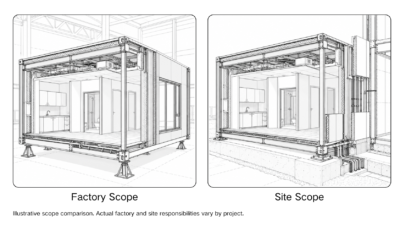
The short answer is that a volumetric module is typically a factory-built three-dimensional unit that becomes part of the completed building after transport, installation, and site integration. What can be completed in a controlled factory environment is fundamentally different from what can only happen once the module is in its final position.
What Can Travel with the Module
In a volumetric modular system, modules can leave the factory with a substantial amount of work already finished. Depending on the project, manufacturing system, and agreed scope, that may include structural framing, wall and floor finishes, windows, doors, insulation, electrical rough-in and wiring, plumbing lines, plumbing fixtures, cabinetry, and sometimes furniture and equipment. In well-optimized projects, the factory can deliver modules with a high degree of internal completion, reducing the amount of skilled trade work needed on site.
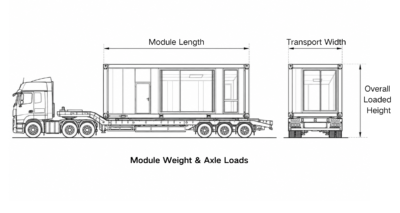
The key constraint is the transport envelope. Module dimensions and weight must be coordinated with applicable transport regulations, permitting requirements, and the selected route. Anything that pushes a module beyond standard transport dimensions—a projecting balcony, an oversized mechanical unit, or an already-installed exterior finish—may need to be left off and added on site. Transport weight also matters. Additional factory-installed scope may increase module weight and, where critical lifting or transport thresholds are reached, may affect crane selection, rigging, or route planning.
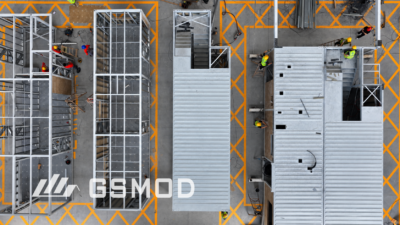
Different stages of steel module assembly illustrate the range of manufacturing activities carried out before site delivery.
What Only Becomes Possible After Installation
Site work in modular construction is not a sign that the factory failed. It is a structural reality. Once modules are crane-lifted onto their foundations, a set of tasks becomes possible that simply could not happen before. Some tasks are generally completed after module installation, while others vary by system design and project delivery model.
Work that is generally site-based in volumetric modular projects includes:
- Module-to-module interfaces, including marriage walls where applicable. Where applicable, module-to-module structural connections and associated sealing or closure work are completed on site in accordance with the approved connection details. The required load path and connection method depend on the structural system.
- MEP tie-ins. Factory-installed wiring and plumbing must be connected across module boundaries and to the site’s risers, corridor feeds, and site utility connections.
- Foundation connections. Tie-downs, welds, and anchor bolts that secure the module to its foundation require explicit responsibility assignment and on-site execution.
- Final integrated testing, commissioning, and balancing, where applicable. Mechanical systems must be verified, electrical systems tested, and plumbing systems checked after all connections are made.
- Final inspections and occupancy approval. Installed work may be subject to required site inspections and final approval procedures before occupancy, depending on the applicable jurisdiction and approval pathway.
Work that varies by system design and project type includes:
- Roof completion and exterior finishes at module seams. In some systems, these are completed in the field; in others, the module is designed with pre-finished edges that require less site work.
- MEP scope allocation. The split between factory-installed and site-installed MEP work depends on the manufacturer’s capabilities and the project’s coordination approach.
- Commissioning responsibilities. Who commissions which systems, and to what standard, is a contractual decision that should be made before production begins.
A reported factory-completion percentage does not, by itself, tell you what interface work remains.
When Can More Factory Completion Create Extra Work?
This is the counterintuitive part: pushing factory completion higher can increase total project cost and schedule risk if the decision is not aligned with transport, access, and inspection realities.
Transport and Protection
Every additional finish installed in the factory must survive the journey. Modules are transported by specialized trailers or other suitable transport equipment over public roads, exposed to vibration, weather, and road debris. Finished surfaces—countertops, cabinetry, flooring, wall finishes—may require protective measures such as wrapping, temporary covers, or corner protection, which can add cost and labor at both ends of the trip. Damage during transport can create repair scope, responsibility, and schedule implications that should be defined in advance.
There is also a weight consideration. A more complete module may weigh more, which can affect crane capacity and transport costs where critical thresholds are reached. A heavier module may require a larger crane, a different rigging configuration, or a route that avoids weight-restricted bridges. Whether this occurs depends on the specific module and the project’s transport and lifting plan.
Access for Connections
Counterintuitively, completing more work in the factory can make the remaining site work harder. If factory-installed finishes block access to the points where modules need to be connected—structurally, electrically, or mechanically—the site crew has to work around them. In some cases, finished walls must be opened up to make connections that could have been designed for easier access.
This is where early coordination between the design team, the manufacturer, and the site contractor or other party responsible for field installation becomes critical. Connection details need to accommodate realistic fabrication, foundation, and installation tolerances.
Inspection and Later Changes
Inspection and regulatory requirements add another layer. Depending on the jurisdiction, off-site construction may be subject to national, state or provincial programs, local authority review, approved third-party plan review, in-plant inspection, or a combination of these. In the United States, this may include state modular programs and Authority Having Jurisdiction (AHJ) oversight. Some regulatory programs may also require approved labels or insignia.
Concealed work must be coordinated with the applicable inspection process before it is closed. If required inspection, documentation, or approval has not occurred, additional access, verification, or corrective work may be necessary. This means the inspection regime must be aligned with the completion strategy from the start—not treated as a site-stage formality.
Additionally, design changes after production begins are disruptive. Once a module enters the production line, changes to layout, MEP routing, or finishes affect the manufacturing process and can cascade through the project schedule. The higher the factory completion level, the less flexibility remains for late-stage changes.
Should This Work Be Completed in the Factory or on Site?
The decision is not about maximizing factory work. It is about placing each scope item where it can be executed with the least total risk and the best overall outcome. The following framework can help project teams work through that decision systematically.
| Decision question | If yes | If no or uncertain |
|---|---|---|
| Is the scope stable before production release? | Factory completion becomes more practical | Preserve flexibility for later decisions |
| Can it survive transport and lifting without excessive protection or rework risk? | Factory may be appropriate | Consider site completion |
| Can required inspection occur before concealment? | Factory completion may work | Maintain inspection access |
| Will factory completion preserve access to structural and MEP interfaces? | Complete earlier | Leave access or closure zone unfinished |
| Does the work depend on final module position or site conditions? | Site may be more appropriate | Factory may be suitable |
| Is responsibility clear at the factory-to-site boundary? | Proceed with defined scope | Resolve the interface first |
This framework does not produce a single right answer for every project. It produces a defensible allocation of scope—one that can be explained, contracted, and executed.
Illustrative Example: MEP Connection Behind a Finished Wall
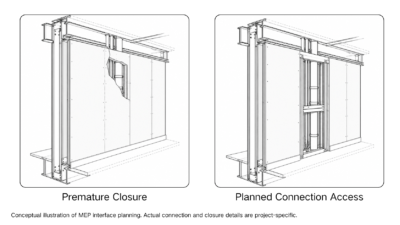
Conceptual comparison showing how premature wall closure may require reopening finished surfaces, while planned access can support site connections and inspections.
Consider a module where the factory installs and finishes the wall that will eventually contain an MEP cross-connection to the adjacent module. The wall looks complete when the module ships. But after the modules are set, the connection still needs to be made. The finished wall now blocks access. The site crew must open the wall, make the connection, and restore the finish—work that could have been avoided if the closure zone had been left unfinished.
Leaving a small access or closure zone unfinished may produce a better total outcome than maximizing the factory-finish percentage. The goal is not to finish everything in the factory. The goal is to finish the right things in the factory.
Why Interfaces Matter More Than a Completion Percentage
The most important concept in modular construction is not the completion percentage—it is the interface. A volumetric modular project combines factory-fabricated scope with site-built scope, each produced under different construction processes, tolerances, responsibilities, and inspection conditions. The critical issue is how those scopes are coordinated at the interfaces.
Module to Module
The connections between modules—structural, MEP, and envelope—are a common area of coordination risk. The term “marriage wall” describes the wall or interface where adjacent modules meet. Depending on the structural and services design, these interfaces may carry structural loads, coordinate floor and roof alignment, and accommodate MEP connections.
Final structural fastening, sealing, and cross-module connections are commonly completed after modules are set. If this scope is not clearly defined in the contract, it becomes a scope gap—and scope gaps can lead to unplanned site cost and change-order exposure.
Module to Foundation
The interface between the module and its foundation is equally critical. Factory-fabricated modules and site-built foundations are produced under different construction processes and tolerance controls. The interface must be detailed to accommodate allowable variation in both. The tie-downs, welds, and anchor bolts that connect the two need a clearly assigned owner and a design that accommodates the tolerance difference.
MEP and Utility Interfaces
MEP connections at module boundaries can be a significant source of scope ambiguity. Factory-installed wiring and plumbing must be connected across modules and to the site’s infrastructure. The connection points need to be accessible, the responsibility for the connection needs to be assigned, and the testing and commissioning of the completed systems needs to be planned.
Scope-related issues can arise when the boundary between the manufacturer’s scope and the site contractor’s scope is unclear. Phrases like “on-site by others” or “by builder on-site” may appear on shop drawings, scope documents, or manufacturer drawings, but what those phrases actually entail can vary widely. The factory may provide materials but not labor. Or it may provide nothing at all. Misreading these phrases can add unexpected site costs.
Why Early Coordination Changes the Result
Factory-to-site interfaces should not be left unresolved until construction. Modular construction places greater importance on front-end coordination because design, procurement, and factory production decisions are made earlier than in many site-built workflows. Once production begins, unresolved interfaces become harder and more expensive to change.
The scope allocation, interface ownership, inspection sequencing, and change procedures should therefore be established before production release—not after modules are already on the line. Early coordination does not guarantee a perfect outcome, but it improves the likelihood that factory and site scopes can be executed as intended.
What a Factory Completion Claim Does Not Tell You
Even when the measurement basis is clear, a reported factory-completion percentage does not tell you:
- What the remaining work actually is. It could be minor finish work, or it could be structural connections, MEP tie-ins, and envelope completion.
- Who is responsible for the remaining work. The factory’s scope may end at the module’s edge, leaving all interface work to the site contractor.
- What it will cost. The remaining site scope can still be commercially significant.
- Whether the module can actually be transported at that completion level. A module that is nearly complete may require a different transport solution, design adjustment, or shifting some scope to site.
- How inspection will be handled. Factory-completed work may still require on-site verification, especially at interfaces.
That is why any reported percentage should be reviewed together with the remaining scope, interface responsibilities, and site completion requirements.
The Right Question Is Which Work Belongs Where
A more useful question is not simply “How complete will the modules be?” but “Which work belongs in the factory, and which work belongs on site?”
That question forces specificity. It requires the manufacturer to define their scope in detail. It requires the site contractor to understand what they are receiving. And it requires the project team to map every interface—structural, MEP, envelope, and regulatory—before production begins.
Factory completion should be optimized for total project outcomes, not maximized as a standalone percentage. The right level of completion is the one that best supports cost, schedule, quality, compliance, transportability, installation access, commissioning, safety, and maintainability given the specific constraints of the project. In some projects, that means pushing more work into the factory. In others, it means deliberately leaving work for the site because doing it in the factory would create more problems than it solves.
Projects are better positioned when the factory-to-site interface is treated as a design and coordination problem early, rather than left primarily for site resolution.
Frequently Asked Questions
Is a modular building completely finished in the factory?
Even highly finished volumetric modules usually require site installation, connections, and final integration before the building is complete. While modules can leave the factory with a high degree of internal completion—including structural framing, finishes, MEP rough-in, and fixtures—site work typically includes final structural and MEP connections, foundation interfaces, integrated testing, and final approval activities. Roof and envelope completion varies by system design. A factory-completion percentage is only meaningful when its measurement basis is defined.
Is a higher factory completion percentage always better?
Not necessarily. Higher factory completion can reduce on-site labor and shorten the construction schedule, but it may also increase module weight, protection requirements, or transport constraints. It can make site connections harder to access and may create inspection complications if factory-completed work needs to be verified on site. The optimal completion level depends on transport constraints, site conditions, inspection requirements, and the coordination maturity of the project team. Pushing completion higher without addressing these factors can increase total project cost and risk.
Why do modules still need connections and testing on site?
Modules are components of a building, not standalone structures in most projects. They must be structurally connected to each other and to their foundation, their MEP systems must be connected across module boundaries and to site infrastructure, and their envelope must be sealed at every joint. These connections can only be made after the modules are in their final position. Factory testing may verify individual modules or components, while final integrated testing and commissioning occur after the building systems are connected on site.
How This Guide Was Prepared
This guide combines GSMOD’s heavy-steel volumetric modular engineering, production-planning, and site-integration experience with relevant off-site construction standards and industry guidance. It focuses on how factory and site scope should be allocated at project interfaces rather than treating factory-completion percentage as a standalone measure of project performance.
Inspection, approval, transport, and site-integration requirements vary by jurisdiction and project delivery model. Project-specific requirements should be confirmed with the relevant design professionals, contractors, manufacturers, and authorities.
Technical References
- ICC/MBI 1200-2021, Standard for Off-site Construction: Planning, Design, Fabrication and Assembly
- ICC/MBI 1205-2021, Standard for Off-site Construction: Inspection and Regulatory Compliance
- ICC/MBI 1210-2023, Standard for Mechanical, Electrical, Plumbing Systems, Energy Efficiency and Water Conservation in Off-site Construction
- Modular Building Institute, Modular by Design: Turning Architecture into a Manufacturing System
Discuss Your Project
Planning a permanent heavy-steel volumetric modular project? Share your project requirements with GSMOD to discuss factory scope, site interfaces and delivery coordination.

Mont Duan
Experienced in modular building engineering, technical design and construction solutions, with a focus on delivering efficient and reliable modular building projects.