

Modular Construction Company, Manufacturer or Supplier in Australia: Who Does What?
If you are procuring a modular building in Australia, you will quickly encounter terms such as modular construction company, manufacturer, supplier, builder, and contractor. These terms are often used interchangeably in conversation, but they do not necessarily mean the same thing. A business that calls itself a modular construction company may not manufacture anything. A supplier may not own a factory. A manufacturer may not take responsibility for site works, approvals, or installation.
This guide focuses on permanent volumetric modular construction and modular integrated construction (MiC) projects. It does not cover portable hire buildings, flat-pack systems or panelised construction.
This guide explains how common modular project roles differ in Australia. It focuses on the procurement question that matters most: not what a company calls itself, but which project responsibilities it actually owns. It also highlights contractual scope, responsibility allocation, and interface ownership. It does not evaluate manufacturers, audit factories, score suppliers, or provide certification checklists.
The central point is simple:
Company labels do not define project responsibility. What matters is who is contractually responsible for each part of the modular project and each interface between them.
Why Company Labels Do Not Define Project Responsibility
Modular construction is not a single service. It is a delivery method that can involve many separate activities:
- architectural and structural design
- engineering and certification
- factory-based module manufacture
- logistics and transport
- planning and building approvals
- site preparation and foundations
- cranage and module installation
- connections, commissioning, and handover
- external works and site finishes
Because these activities can be combined or separated in different ways, a company’s name is not a reliable guide to its actual project responsibility. One modular construction company may offer a full turnkey service. Another may only manufacture modules and deliver them to site. A supplier may act as a procurement interface between the buyer and a local or overseas factory.
The same company label can also correspond to very different contractual scopes. A “modular construction company” in one project may be a manufacturer-led business. In another, it may be a builder-led contractor. In a third, it may be a project coordinator that does not own a factory or employ site trades directly.
The key question is not “What is this company called?” but “What is this company contractually responsible for?”
The Modular Project Responsibility Chain
Before looking at individual roles, it helps to map the project as a chain of responsibilities. A modular project can be divided into seven main stages.
| Project Stage | Core Question |
| Design and Engineering | Who is responsible for the coordinated design? |
| Approvals | Who manages the approval pathway? |
| Factory Manufacturing | Who actually manufactures the modules? |
| Transport and Logistics | Who is responsible for transport and delivery sequencing? |
| Site and Foundations | Who prepares the site and foundations? |
| Installation and Connections | Who installs and connects the modules? |
| Commissioning, Handover and Defects | Who commissions, hands over, and manages defects? |
Different businesses may own different parts of this chain. Some may own only one stage. Others may own several. The important procurement task is to identify who is responsible for each stage and who is responsible for the interfaces between them.
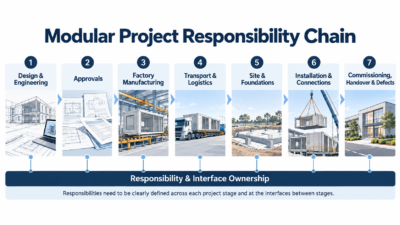
Responsibility should be defined for both individual project stages and the interfaces between them.
What Is a Modular Building Manufacturer Usually Responsible For?
A modular building manufacturer is primarily distinguished by its responsibility for factory-based module production, although its contracted scope may extend beyond manufacture. Depending on the manufacturer and the project, this can include:
- production engineering and shop drawings
- module fabrication, including structural framing
- structural work such as steel, timber, or concrete module frames
- factory fit-out, including internal linings, joinery, and finishes
- rough-in and sometimes final services within the module
- quality assurance and quality control during manufacture
- manufacturing documentation and project-required compliance evidence
A manufacturer may also provide design assistance, but this does not automatically make them responsible for the full building design. A manufacturer may deliver modules to site, but this does not automatically make them responsible for installation, site works, or building approvals.
A manufacturer does not automatically take responsibility for:
- whole-building design
- statutory approvals
- site works
- installation
- commissioning
Manufacturing capability and project-wide responsibility are different questions. A manufacturer is not automatically a turnkey contractor.
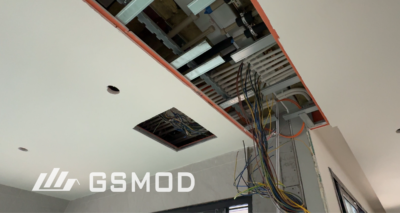
Building-services rough-in and interior coordination during factory fit-out of a volumetric module. The exact factory scope varies by project and contract.
What Does a Modular Construction Company Actually Mean?
“Modular construction company” is a commercial description, not a fixed statutory project role. It may describe very different types of businesses, including:
- a manufacturer-led provider
- a builder-led contractor
- a design and construct provider
- a project coordinator
- a vertically integrated provider
- A modular construction company may offer a broader scope. In some cases, it may cover:
- project coordination and project management
- design coordination
- procurement of materials and modules
- manufacture, either in its own factory or through a manufacturing partner
- construction and site works
- installation and commissioning
However, the scope of a modular construction company varies widely. Some companies are essentially project managers that coordinate other parties. Others are vertically integrated and control design, manufacturing, transport, and installation. Some focus only on certain building types, such as modular homes, schools, clinics, or commercial buildings.
For buyers, the important point is that “modular construction company” is a broad label. It does not tell you whether the company manufactures, builds, installs, or simply coordinates. The real question is which parts of the responsibility chain it contractually owns.
What Does a Modular Building Supplier Actually Supply?
A modular building supplier may be any of the following:
- a manufacturer selling its own modules
- a distributor or agent for one or more manufacturers
- a procurement interface between the buyer and a factory
- a project coordinator that sources modules and arranges delivery
- a reseller of imported modular buildings
Do not assume that a supplier owns a factory. Some suppliers own manufacturing facilities; others source from third-party manufacturers. A supplier may source modules from a local manufacturer, an overseas manufacturer, or a combination of both. The supplier’s responsibility may end at delivery, or it may extend to installation and site coordination.
If you are buying from a supplier, you need to confirm:
- Who actually manufactures the modules?
- Who is the buyer’s contractual counterparty?
- Who is responsible after delivery?
A commercial role description is not, by itself, a complete statement of statutory duties. A supplier may have legal or work health and safety obligations in certain contexts. This page does not explore those duties in detail. It simply notes that the commercial label “supplier” should not be treated as a full description of legal responsibility.
Where Builders, Contractors and Statutory Roles Fit
In Australia, modular projects still require site-based construction work. This is where builders and contractors fit in. Common roles include:
- Builder or head contractor — depending on the project structure, may hold contractual responsibility for site delivery, sequencing and trade coordination, subject to licensing requirements and the relevant jurisdiction.
- Principal contractor — a specific construction safety role under the applicable jurisdictional framework.Its definition and duties depend on the relevant jurisdiction. It may be the same organisation as the head builder, but the terms should not be treated as synonyms.
- Site contractor — may be responsible for site preparation, foundations, and civil works within its contracted scope.
- Civil contractor — may be responsible for earthworks, drainage, access, and external services within its contracted scope.
- Installation contractor — may be responsible for cranage, module placement, and structural connections within its contracted scope.
- Services subcontractors — may be responsible for mechanical, electrical, hydraulic, and fire services connections and commissioning. These are often referred to later as services contractors or subcontractors.
A modular manufacturer may have its own installation team, or it may subcontract installation. A head builder may be appointed separately by the client, or the modular construction company may take on that role.
These roles may sit with one organisation or several organisations depending on the delivery model and jurisdiction. The critical issue is interface responsibility. Who is responsible for the connection between the module and the foundation? Who coordinates the crane? Who signs off on services connections? These questions must be answered before work begins.
Who Is Responsible for Design, Engineering and Approval?
Design and engineering responsibility is one of the most common sources of confusion in modular projects. The table below provides a possible responsibility allocation. It is illustrative only. Actual contractual and statutory responsibility depends on the delivery model, discipline, and jurisdiction.
| Responsibility | Possible Party | What Must Be Clarified |
| Architectural design | Client architect, modular provider, or design consultant | Who is responsible for the coordinated design? |
| Structural design | Structural engineer, including one engaged within a design and construct team | Who signs off the project structural design? |
| Module engineering | Manufacturer or specialist module engineer | Who is responsible for module-specific engineering and shop drawings? |
| Services design | Services consultant or integrated provider | Who is responsible for the factory-to-site services interfaces? |
| Approval coordination | Client, project manager, head contractor, modular provider, or consultant team | Who prepares, coordinates, lodges, and manages project-side submissions? |
| Statutory assessment, certification or determination | Building surveyor, certifier, council or other statutory decision-maker, depending on jurisdiction | Who carries out the statutory assessment, certification or approval under the applicable state or territory framework? |
In Australia, building regulation and approval administration operate through state and territory frameworks. Requirements for design documentation, engineering certification, and building approvals vary between states and territories. Modular projects may require project-specific engineering input to address module design, structural interfaces and other technical matters, and to support the evidence required for the applicable approval pathway.
A manufacturer may have in-house engineers, but that does not automatically mean the manufacturer can provide the statutory certification or approval required for the project. Buyers should confirm which appropriately registered engineers, building surveyors or certifiers are required, who will engage them, and which approval authority applies to the project and jurisdiction.
Who Actually Manufactures the Modules?
Factory manufacturing may be handled in several ways:
- Own factory — the company manufactures modules in its own facility.
- Outsourced manufacturing — the company contracts another factory to manufacture the modules.
- Manufacturing partner — the company works with a partner factory, sometimes overseas, under a commercial arrangement.
This distinction is about role, not quality. A company without its own factory can still deliver a successful modular project if it manages manufacturing partners effectively. A company with its own factory may still outsource certain components or finishes.
For buyers, the key is to identify the actual manufacturing entity. The contracting entity and the manufacturing entity may not be the same organisation. If the company you are contracting with does not own the factory, you should understand who does, where it is located, and who is responsible for manufacturing quality controls and project-required manufacturing documentation.
This section only asks who manufactures. It does not assess which factory is better, how to audit a factory, or how to score a supplier.
Who Handles Transport, Installation and Site Works?
Transport, installation, and site works are often split across multiple parties. Typical responsibilities include:
- Logistics and transport — may be handled by the manufacturer, a specialist transport contractor, or the supplier.
- Foundations and site preparation — may be handled by a civil or site contractor.
- Cranage — may be provided by a crane contractor, sometimes engaged by the installation contractor or head builder.
- Module installation — may be carried out by the manufacturer’s installation team, an installation contractor, or the head builder.
- Connections — services subcontractors for electrical, plumbing, hydraulic, mechanical, and fire services.
- External and site works — civil contractor, landscaper, or head contractor.
In some modular projects, the manufacturer delivers modules to site and the client’s builder takes over from there. In other projects, the modular company manages the entire process.
There is no single standard. The contract must define who is responsible for each interface. It should also clarify where the factory scope ends and where the site scope begins.
Who Owns the Factory-to-Site Interfaces?
Important responsibility gaps in modular projects can occur at interfaces between parties.
Factory-to-site interfaces can include:
- module to foundation
- module to site services
- manufacturer to installation contractor
- factory engineering to local engineering
- transport to cranage
- module placement to structural connection
- façade completion to installation
- manufacturing documentation to approval evidence
- The core question is:
- Who is responsible when the factory scope ends and the site scope begins?
If responsibility for that transition is not clearly allocated, gaps can emerge in design coordination, site readiness, installation, testing or project documentation. A responsibility matrix should therefore cover not only each project stage, but also every major interface between factory and site.
What Does “Turnkey Modular Construction” Actually Mean?
“Turnkey” is a commonly used term in modular construction, but it is not a fixed scope. A turnkey proposal may include:
- design and engineering
- manufacture
- transport
- site preparation
- foundations
- installation
- connections and commissioning
- approval coordination and certification-related services
Or it may exclude some of these items. Some turnkey contracts exclude foundations, cranage, external works, or utility connections. Others exclude design or approvals.
Buyers should not rely on the word “turnkey” alone. They should ask for a detailed inclusions and exclusions schedule. The schedule should clearly state who is responsible for each phase, what is included in the contract price, and what will be charged separately.
Turnkey is only meaningful when the scope is defined. It cannot replace:
- inclusions and exclusions
- a responsibility matrix
- interface ownership
- statutory role clarification
What Should Buyers Clarify Before Contract Signing?
Before contract signing, buyers should clarify responsibility for every major project interface. Useful questions include:
- Who is responsible for architectural design?
- Who is responsible for structural design and module engineering?
- Who will coordinate and manage the planning and building approval process?
- Who will manufacture the modules, and where?
- Who is responsible for quality control during manufacture?
- Who will transport the modules to site?
- Who will prepare the site and construct foundations?
- Who will provide cranage and install the modules?
- Who will complete connections and commissioning?
- Who will manage defects and warranty obligations?
- Who is responsible for every major interface between factory and site?
A simple responsibility matrix, agreed in writing before contract signing, can prevent costly assumptions later.
If a major responsibility cannot be clearly assigned, it is not yet resolved.
Which Delivery Model Fits Your Project?
The right partner depends on your delivery model and your internal capabilities. Common models include:
- Manufacture-only — you manage design, approvals, transport, site works, and installation separately.
- Manufacture plus installation — the manufacturer delivers and installs modules, but you manage other site works.
- Supplier-led procurement — you use a supplier to source modules, while you retain control of the rest of the project.
- Integrated modular delivery — one provider coordinates design, manufacture, transport, and installation, often as a head contractor.
- Broader design and construct or turnkey delivery — one party takes responsibility for the agreed scope from design to handover, subject to clear inclusions and exclusions.
This is not a recommendation of any specific business. It is a way to match your project’s needs with the role a partner is actually able to perform.
The choice is not simply a company label. It is a responsibility allocation model.
FAQ
FAQ 1 — Is a modular building manufacturer the same as a modular construction company?
Not necessarily. A manufacturer is primarily responsible for factory-based module production. A modular construction company may take on a wider scope, including design coordination, site works, installation, and project management. Some companies are both, but the terms are not interchangeable. It depends on the contracted scope.
FAQ 2 — Does a modular supplier always manufacture its own buildings?
No. A supplier may be a manufacturer, a distributor, an agent, or a procurement interface. Some suppliers own manufacturing facilities; others source from third-party manufacturers. Buyers should confirm the actual manufacturing entity and its location.
FAQ 3 — Do I still need a builder if I use a modular manufacturer?
It depends on the contract model and the site scope. If the manufacturer only supplies modules, other appropriately appointed and, where required, licensed parties will still be needed for site works, foundations, installation and related project responsibilities. The required builder and WHS roles should be confirmed for the relevant jurisdiction and delivery model. If the modular provider’s contracted and appropriately licensed scope includes the relevant site building work, a separate builder may not be required for that same scope. However, builder licensing, statutory roles, and jurisdiction-specific responsibilities still need to be confirmed.
FAQ 4 — Who is normally responsible for modular building approvals in Australia?
There is no single national answer. Building regulation and approval processes operate through state and territory frameworks, and responsibility depends on the project delivery model and jurisdiction. Responsibility for coordinating an approval application may sit with the client, contractor, modular provider or consultant team. Statutory assessment, certification or approval is carried out by the relevant professional or authority under the applicable state or territory framework. This should be clarified at the start of the project with local professional advice.
FAQ 5 — What should “turnkey” include in a modular construction proposal?
“Turnkey” should be treated as a starting point, not a complete scope. Buyers should ask for a detailed inclusions and exclusions list covering design, engineering, approvals, manufacture, transport, foundations, cranage, installation, connections, commissioning, and external works. Each item should be confirmed in writing.
Official References
- Australian Building Codes Board — Prefabricated, modular and offsite construction handbook
- Safe Work Australia — Model WHS laws and jurisdiction guidance
Review Note / Disclaimer
Content reviewed against publicly available ABCB/NCC and Safe Work Australia sources in September 2026. This guide is for general information only and does not constitute legal, WHS, engineering or professional advice. Contractual responsibilities, licensing, statutory roles and approval requirements vary by project and jurisdiction. Project-specific requirements should be confirmed with appropriately qualified professionals and the relevant authority.

Vincent Y.N. Mak
16 years of experience in modular architecture, MiC construction and international modular project management.