

Why an Early Modular Office Budget Can Change
An early project budget is based on the information available at that stage. As scope, design, site conditions and delivery requirements become clearer, the budget may need to be refined. This is not necessarily the same as a cost overrun.
For this guide, a cost overrun refers to project cost exceeding an established budget or approved cost baseline, whether already incurred or forecast at completion. Many early budget changes, by contrast, reflect normal project development: information improves, assumptions are replaced with confirmed data, and the budget is updated accordingly.
In volumetric modular construction, the relationship between design, manufacturing, transport and site installation is highly integrated. Changes in one area can affect others. This makes early coordination particularly important, but it does not mean modular projects are inherently riskier than conventional construction. It means the cost implications of design and delivery decisions should be understood early.
This guide explains why an early modular office budget may change as project information develops, and which cost risks should be addressed early to make the budget more reliable. For the broader project-cost drivers that shape a modular office budget, see our guide to modular office cost in Australia.
In this guide, design freeze refers to an agreed project milestone at which the principal design inputs are sufficiently developed for coordinated procurement, manufacturing and delivery planning. It is a project-control milestone, not a regulatory requirement.
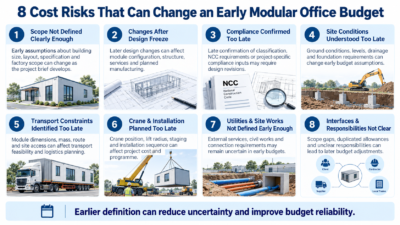
1. Project Scope Is Not Defined Clearly Enough
An early modular office budget may change because the project scope is not yet fully defined.
Early budgets are often based on preliminary information: an approximate floor area, a conceptual layout, and assumptions about fit-out standards and building services. These assumptions are reasonable at an early stage, but they carry uncertainty.
Changes in building size may affect module count, module dimensions or overall configuration. When room functions are revised, the internal layout and building services distribution may need to be adjusted. When performance requirements are clarified, the specification may need to be revised accordingly. Each of these scope developments can affect the budget.
Building Requirements Are Still Developing
At the time of an early budget, the project may not have a fully developed brief. The number of workstations, the mix of open-plan and enclosed offices, the size and location of meeting rooms, and the provision of amenities such as kitchens and breakout spaces may still be under discussion.
As these requirements become more clearly defined, the building layout, module configuration and internal fit-out scope may change. The budget may need to be revised as the brief develops.
Client Requirements Are Clarified or Added Later
Some client requirements may not be fully articulated at the outset. They may emerge or be clarified during design development: acoustic performance expectations, specific security requirements, enhanced data and AV infrastructure, or preferred materials and finishes.
When requirements are clarified or added after the early budget was prepared, the budget may need to be revised to reflect the updated scope. This should not automatically be treated as scope creep; in many cases it reflects normal project definition.
2. Design Changes Occur After the Agreed Design Freeze
Once the design has been sufficiently developed and the design freeze milestone has been agreed, changes should be formally managed. However, design changes can still occur after this point.
Because modular buildings are designed as coordinated systems, changes after design freeze can affect multiple aspects of the project. A layout change may affect module configuration, structural interfaces and building services routing. A building services change may affect service zones, structural openings, equipment loads, fire-resisting construction or module interfaces. These knock-on effects can lead to design revisions, documentation updates and, in some cases, adjustments to planned manufacturing activities.
Layout Changes
Changes to the internal layout—moving walls, relocating stairs, adjusting corridor widths, or adding or removing rooms—can affect module configuration and the coordination of structure and services. Where layout changes occur after design freeze, the budget may need to be reassessed.
Building Services Changes
Changes to electrical, mechanical or hydraulic services—whether in capacity, routing or equipment selection—can have implications for module design. Services are coordinated with the module design, so later changes may require design revisions and adjustments to planned manufacturing activities.
Structural and Interface Changes
Changes to structural design, load paths, openings, or module-to-module connection details may affect multiple modules and require coordinated engineering updates. Where these changes occur after design freeze, they may also affect the manufacturing programme.
3. Compliance Requirements Are Confirmed Too Late
Compliance requirements are project-specific. They depend on factors including the building classification, intended use, project location, applicable NCC edition and jurisdiction-specific requirements.
If the applicable compliance framework is not confirmed early enough, design assumptions may need to be revised later. Fire-resisting construction, accessibility, energy efficiency, structural design inputs and other compliance requirements can all affect the design and specification.
Where compliance requirements are confirmed later in the project, changes to the design, materials or documentation may be required. These changes can affect the budget and, in some cases, the manufacturing programme.
The applicable NCC edition and jurisdiction-specific requirements should be confirmed for the project location as early as possible. Project-specific compliance responsibilities should be confirmed within the agreed delivery model and with the relevant qualified professionals. This is not about identifying all technical details at the outset, but about establishing the framework within which the design will need to comply.
4. Site Conditions Are Not Understood Early Enough
Site conditions can affect budgets in any construction project. In volumetric modular construction, site information also informs module design, transport and installation planning, making early coordination particularly important.
Early budgets may rely on preliminary assumptions about site conditions if sufficient geotechnical information is not yet available. As site investigation progresses and information becomes more reliable, the assumptions used in the early budget may need to be revised.
Ground Conditions
Ground conditions can influence foundation design and site-preparation requirements. If later investigation identifies conditions that differ materially from the assumptions used in the early budget, the foundation and site works scope may need to be revised.
Levels, Drainage and Site Preparation
As survey and civil design information develops, previously assumed earthworks, drainage or site-preparation allowances may need to be revised.
Foundation Requirements
Foundation design should be informed by project-specific geotechnical information and engineering assessment. Where foundation requirements are not yet fully defined, an early budget may include provisional allowances that need to be refined once geotechnical information is available and structural loads are confirmed.
5. Transport Constraints Are Identified Too Late
Transport is a critical consideration in volumetric modular construction. Modules are manufactured off site and must be delivered to the project site. If transport constraints are identified too late, the module configuration may need to be revised, or additional logistics costs may be incurred.
Module Dimensions and Mass
Module dimensions and mass affect transport feasibility. A module configuration developed without considering transport constraints may later require design changes or special transport arrangements. Module mass and dimensions should be reviewed against transport routes and access conditions during design development.
Route Restrictions and Access
Transport routes vary by location, jurisdiction and vehicle/load configuration. Where module dimensions or mass result in an oversize or overmass (OSOM) vehicle/load configuration, route access, notices, permits or other transport requirements may need to be considered. Requirements vary by route, jurisdiction and vehicle/load configuration, and should be assessed on a project-specific basis.
Site Delivery Constraints
Site access conditions—turning radius, overhead clearances, street width, and the availability of a suitable staging area—can affect transport and installation. If these constraints are not identified early, delivery and installation planning may need to be revised, potentially affecting cost and programme.
6. Crane and Installation Planning Happens Too Late
Crane and installation planning is closely linked to module mass, site access and the installation sequence. If planning begins too late, previously unbudgeted requirements may emerge.
Crane position, lift radius, site access for the crane, and laydown or staging areas for modules all need to be considered. The installation sequence—which modules are installed first, which need to be lifted over previously installed modules, and how structural and services connections are made—can also affect crane requirements.
Late planning can reveal requirements that were not reflected in the early budget, such as revised crane capacity requirements, revised lifting sequences or longer crane utilisation. These requirements are project-specific and should be reviewed during design development rather than after module geometry has been finalised.
7. External Utilities and Site Works Are Not Defined Early Enough
External utilities and site works may be defined later in the project than the building design itself, creating uncertainty if key interfaces are not addressed early.
Connection locations, available service capacity, and the requirements of the relevant utility authorities all affect the scope of external works. If these are not defined early, the assumptions used in the budget may need to be revised.
Responsibility and scope for external utilities and site works depend on the agreed delivery model and should be defined early. Until those interfaces are confirmed, the early budget may need to carry assumptions or provisional allowances for these items.
8. Project Interfaces and Responsibilities Are Not Clear
Modular projects involve multiple parties: the client, the design team, the modular manufacturer, the builder or installer, and various consultants and subcontractors. If responsibilities and interfaces are not clearly defined, budget changes can result.
Unclear interfaces can lead to scope gaps—work that no party has allowed for. They can also lead to duplicated scope—work that two parties have allowed for separately. Late clarification of responsibilities can require redesign, variations, or additional coordination.
Where scope boundaries are unclear, the budget may need to be revised once responsibilities are confirmed. This risk is not unique to modular projects, but the integrated nature of modular delivery makes early clarification of interfaces particularly important. For a detailed breakdown of factory scope, site scope, exclusions and responsibility interfaces, see our guide to what is included in a modular office quote.
How to Build a More Reliable Modular Office Budget
The following practices can help improve budget reliability by reducing uncertainty and identifying potential cost changes earlier.
Define the Project Scope Early
Defining the project brief and scope as far as practical reduces the number of assumptions carried into each budget update. Key functional requirements, approximate building size, layout intent and expected specification levels should be progressively clarified as the budget develops.
Establish a Design Freeze Process
An agreed design freeze milestone provides a clear point after which design changes are formally managed. The design freeze milestone should be identified in the project programme and understood by the relevant project parties. Changes after design freeze should be subject to a formal change control process.
Confirm Key Compliance Inputs Early
The applicable NCC edition, building classification and key regulatory requirements should be confirmed for the project location as early as possible. This does not mean completing all compliance documentation at the outset, but establishing the framework within which the design will need to comply.
Investigate Site Conditions Early
Relevant geotechnical investigation and site survey information should be obtained as early as practical for project planning. The earlier site conditions are understood, the sooner foundation and site works assumptions can be refined.
Review Transport and Installation Together
Module dimensions, mass, transport routes and installation access should be reviewed together during design development. Identifying constraints before module geometry is finalised reduces the likelihood of late changes.
Clarify Scope Interfaces and Responsibilities
Key interfaces between module supply, transport, site works, installation and approvals should be clearly defined, together with the relevant responsibilities. This helps avoid scope gaps and duplicated allowances.
Use Change Control After Design Freeze
After design freeze, changes to scope, design or specification should be managed through a formal change control process. This helps ensure that the cost and programme implications of changes are understood before they are approved.
Maintain an Appropriate Project Contingency
A project budget may include a contingency allowance to reflect identified uncertainty and risk. The appropriate level depends on project maturity, identified risks and the organisation’s cost-planning approach. Contingency should not be used as a substitute for defining known project scope. It is a risk allowance, not a scope buffer.
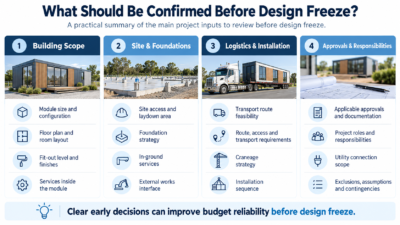
Which Budget Risks Should Be Addressed Before Design Freeze?
The following table provides a framework for identifying which budget risks should be addressed before the design freeze milestone.
| Risk Area | Before Design Freeze, Confirm / Assess |
| Project scope | Key functional requirements, approximate GFA, layout intent, specification level |
| Compliance | Applicable NCC edition, building classification, key regulatory requirements |
| Site conditions | Available geotechnical and survey information, site access constraints |
| Transport | Preliminary module transport feasibility, route and access review |
| Installation | Access and lifting strategy, installation sequence considerations |
| Services | Major building services requirements and interface points |
| Responsibilities | Key scope interfaces and responsible parties |
| Budget assumptions | Remaining assumptions, unresolved risks and contingency approach |
Frequently Asked Questions
Why can a modular office budget change after the initial estimate?
An early budget is based on the information available at that time. As the project develops—scope becomes clearer, design develops, site conditions are confirmed and delivery requirements are clarified—assumptions are progressively replaced with confirmed information. Budget changes at this stage reflect normal project development rather than necessarily indicating a problem.
Can design changes affect a modular office budget?
Design changes after an agreed design freeze can affect cost, programme or both, depending on their extent and when they occur. In volumetric modular construction, changes can have knock-on effects across module configuration, structural interfaces and building services coordination. A formal change control process helps manage these implications.
Can site conditions affect a modular office budget?
Yes. Ground conditions, site levels, drainage requirements and foundation assumptions may be based on preliminary information in an early budget. As geotechnical and survey information becomes available, these assumptions may need to be revised, which can affect the site works and foundation scope.
Why should transport constraints be reviewed before design freeze?
Module dimensions and mass affect transport feasibility. If transport constraints are identified after module geometry has been finalised, design changes or additional logistics costs may be required. Reviewing transport and installation together during design development helps identify constraints earlier.
Can unclear project responsibilities increase the final cost?
Unclear interfaces and responsibilities can lead to scope gaps, duplicated allowances, late coordination, redesign or variations. Early clarification helps reduce the risk of these issues affecting the budget later.
Should a modular project budget include contingency?
A project budget may include a contingency allowance to reflect identified uncertainty and risk. The appropriate level depends on project maturity, identified risks and the organisation’s cost-planning approach. Contingency should be used as a risk allowance, not as a substitute for defining known project scope.
How can developers reduce modular project cost overruns?
Early scope definition, coordinated design, early site investigation, transport and installation planning, and clear interface management can reduce uncertainty and help teams identify potential cost changes earlier. These practices improve budget reliability without guaranteeing that changes will not occur.
How This Guide Was Prepared
This guide combines GSMOD’s volumetric MiC project-planning and design-coordination knowledge with current Australian building-regulation and heavy-vehicle transport guidance. It focuses on early-stage budget uncertainty and project risk rather than project-specific cost advice.
Official References
- Australian Building Codes Board (ABCB) — Building classifications
- Australian Building Codes Board (ABCB) — General NCC FAQs
- National Heavy Vehicle Regulator (NHVR) — Oversize Overmass
This guide is for general information purposes only and does not constitute professional advice. Project-specific budgeting and cost planning should be undertaken by appropriately qualified professionals. Budget changes should not automatically be interpreted as cost overruns without reference to the agreed project baseline and scope.

Vincent Y.N. Mak
16 years of experience in modular architecture, MiC construction and international modular project management.