

Why Modular Office Quotes Can Be Difficult to Compare
If you have received modular office quotes from two different suppliers and found them nearly impossible to compare, you are not alone.
This is a common source of confusion in modular procurement. One supplier quotes a price that seems significantly lower. Another supplier quotes a higher figure but includes scope the first supplier left out. Without a clear understanding of what each quote actually covers, comparing them is like comparing two different products.
The reason is straightforward: quoted price does not mean identical scope. A lower quoted price may reflect a narrower scope of supply rather than better value.
This guide breaks down what may be included in a modular office quote, what may sit outside the quoted scope, and—most importantly—how to compare quotations on a like-for-like basis.
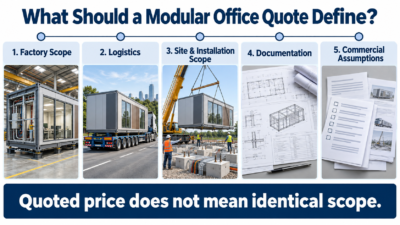
A modular office quote should clearly define five things:
| Factory scope | Logistics | Site and installation scope | Documentation | Commercial assumptions |
What Is Included in the Factory Supply Scope?
The factory supply scope often forms a core component of a modular office quote. It identifies the work and components to be manufactured, assembled or finished in the factory under the agreed scope of supply. However, the extent of this scope varies significantly depending on the supplier and the agreed factory completion level.
Structural Module and Building Envelope
The structural module comprises the primary structural system of the building. For GSMOD projects, the factory supply may include a heavy‑steel volumetric structural system designed to the project‑specific structural and compliance requirements. The structural scope may include the load‑bearing frame, floor structure, and lifting points designed into the module for crane installation.
The building envelope—external walls, roof, windows, and external doors—may be factory‑installed depending on the agreed factory completion level and project scope. The quotation should clearly identify the proposed cladding material, insulation specification, window and glazing specification, and roofing system. The quotation should also identify the proposed insulation and building‑envelope specification so that it can be assessed against the applicable project energy‑efficiency requirements.
Interior Fit‑Out
The interior fit‑out scope defines the internal finishes, linings, doors, floor finishes, joinery and fixtures included in the quotation. This is where quotes can vary substantially.
A modular office quote may include factory‑installed internal wall linings and ceiling systems, commercial‑grade flooring, internal doors, and basic joinery such as kitchen cabinetry. The quotation should clearly state the wall lining material, finish, acoustic performance, and flooring specification. Joinery quality varies significantly between quotes, and the quotation should specify what standard is included and what would be an upgrade.
The key principle is simple: the quote should clearly state what is included and to what specification.
Building Services
Building services—electrical, mechanical, and hydraulic services—may be factory‑installed depending on the agreed factory completion level and project scope.
The electrical scope may include power outlets, lighting, distribution boards, and data cabling rough‑in. The quotation should specify the number and type of power outlets per workstation and the lighting layout. Mechanical services may include heating, ventilation, and air conditioning (HVAC). Hydraulic services may include plumbing rough‑in for wet areas such as kitchens, bathrooms, and breakout spaces.
The quotation should identify which elements are factory‑installed and which require site completion. Fire‑related components—including active fire services and passive fire‑resisting construction—should be identified, together with the interfaces that require completion or coordination on site.
Factory Completion Level
The factory completion level is one of the most important factors in any modular quote. It determines how much work is completed in the factory versus how much remains for site completion.
At one end of the spectrum, shell‑only modules include the structural frame, roof, cladding, windows, and doors. The remaining fit‑out and services scope is completed on site according to the agreed delivery model.
At the other end, high factory completion modules arrive with a substantial proportion of structure, services, and finishes completed in the factory. The remaining site scope depends on the project design and agreed delivery model.
The factory completion level materially affects both the quoted supply price and the on‑site work required. A lower supply price may reflect a lower completion level, which may shift additional work and cost to site. Because supplier terminology can vary, compare the actual scope and completion deliverables rather than relying on labels alone.
What Is Included in the Logistics Scope?
Logistics costs are often a source of confusion in modular quotes. Some suppliers include transport in their price. Others exclude freight from the quoted scope, with transport arranged separately. The agreed delivery terms define how logistics responsibilities, costs and risk are allocated.
Factory to Port
Inland transport from the factory to the port of export may be included or excluded, depending on the delivery terms and scope of supply.
International Freight
Ocean freight from the port of export to the nominated Australian port may be included or excluded. The quotation should identify the applicable Incoterms® 2020 rule and the named place or port, where Incoterms are used.
Australian Port and Import Scope
The Australian port and import scope may include terminal handling, unloading, storage, customs clearance and other import‑related activities. The quotation should state whether Australian port charges, customs clearance, applicable duties, import GST, and other import‑related charges are included, excluded, or allocated to another project party.
Port to Site and Oversize/Overmass (OSOM) Transport
Onward transport from the Australian port to the project site may be included or excluded. Modules that result in an oversize or overmass (OSOM) vehicle/load configuration may require route assessment, applicable notices or permits, and pilot or escort arrangements depending on the route, jurisdiction and vehicle/load configuration. These requirements may create additional project-specific transport costs and should be explicitly addressed in the quotation.
The key question to ask: To what point is transport included? Factory gate, port of loading, Australian port, or project site?
What Is Included in Installation and Commissioning?
Installation—the process of placing modules on site and connecting them into a complete building—may be included or excluded depending on the agreed delivery scope.
Craneage and Module Placement
Crane hire for lifting modules from the transport vehicle or staging area into their final position may be included or excluded. The quotation should state whether craneage and module placement are included, and if not, who is responsible.
Structural Connections
Connecting modules together structurally—bolting, welding, or other fixing methods—may be included or excluded. The quotation should clarify what structural connection materials and details are provided versus what is installed on site.
Building Services Connections
Connecting module services to site services—water, sewer, power, communications, gas—may be included or excluded. The quotation should clarify which connection points are provided and what remains for site installation.
Testing and Commissioning
Final testing and commissioning of building services—after all connections are made—may be included or excluded. The quotation should specify whether the supplier provides commissioning support or documentation, and who is responsible for each stage.

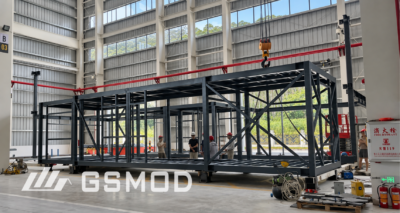
Heavy-steel volumetric module during factory production at GSMOD.
What Is Commonly Outside the Factory Supply Quote?
Understanding what is not included is as important as understanding what is. The following items are often priced separately from the factory module supply, but responsibility depends on the agreed delivery and contract scope.
Site Investigation and Foundations
Foundations—whether slab, footings, piers, or piles—are site‑specific and commonly priced separately. Foundation design should be informed by project‑specific geotechnical information and engineering assessment.
Civil and External Works
External site works may include earthworks, site drainage and stormwater infrastructure, paving, car parks, fencing and landscaping. These works are project‑specific and may be priced separately from the factory module supply.
External Utilities
Connections to external utilities—water mains, sewer, electrical grid, telecommunications, and gas—are site‑based works and may be priced separately from the factory module supply. The quotation should clarify how these connections are addressed.
Project-Specific Engineering, Approval and Certification
Project-specific engineering, planning and building approvals or permits, inspections, and certification requirements depend on the applicable jurisdiction and project. The supplier may provide engineering and product documentation that can form part of the project’s Evidence of Suitability, where applicable. The quotation should state what documentation is included, while responsibility for project-specific approvals and certification should be clearly defined.
What Engineering and Documentation Deliverables Are Included?
A professional modular office quotation should not only define the physical scope. It should also identify what engineering and compliance documentation is provided as part of the supply.
The quotation should clarify whether the following are included:
- shop drawings
- structural documentation and calculations (where included)
- product technical data
- agreed testing reports, certificates and other supporting evidence, where applicable
- documentation intended to support Evidence of Suitability, where applicable
- operation and maintenance (O&M) documentation (if included)
- installation information and interface details
- as‑built documentation (if included)
Not all of these are necessarily included in every quotation. The key point is that the quotation should clearly specify what is supplied and what is not.
What Assumptions Is the Quote Based On?
Every modular office quote is based on a set of assumptions. These assumptions determine the accuracy and validity of the price. A quote is only as reliable as the assumptions it is based on.
Key assumptions to check:
- Drawings and revision– Which drawings and revision were used to prepare the quote? Changes after the quote may affect the price.
- Gross floor area (GFA)– What floor area is the quote based on? Changes to building size affect module count and cost.
- Module configuration– How many modules? What are their dimensions? What configuration—single‑storey, multi‑storey, with or without corridors, stairs, and amenities?
- Finish specification– What fit‑out standard is assumed? Standard, mid‑range, or premium?
- Factory completion level– Is the quote for shell‑only, partial factory completion, or high factory completion?
- Building services– What services scope is included? Power outlet density, data cabling, HVAC capacity, and hydraulic scope?
- Site information– What site conditions are assumed? Soil type, slope, access, and utilities availability?
- Logistics basis– To what point is transport included? Who bears the cost and risk at each stage?
The quotation or contract terms should state how changes to the pricing assumptions will be treated.
Who Is Responsible for Each Scope?
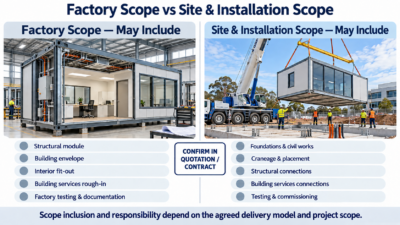
Factory and site scope are not fixed across all modular projects. Inclusions and responsibilities should be confirmed in the project-specific quotation and contract.
Responsibility for each scope element depends on the agreed delivery model and contract terms. The following matrix provides a framework for identifying what is included, excluded, or to be confirmed.
| Scope Element | Included in Quote? | Responsible Party | Interface / Notes |
| Structural module manufacture | To be confirmed | To be confirmed | Confirm scope of supply |
| Building envelope | To be confirmed | To be confirmed | Confirm cladding, insulation, windows, roof |
| Interior fit‑out | To be confirmed | To be confirmed | Confirm finish specification and inclusions |
| Building services rough‑in | To be confirmed | To be confirmed | Confirm electrical, mechanical, hydraulic scope |
| Engineering and documentation deliverables | To be confirmed | To be confirmed | Confirm drawings, calculations, Evidence of Suitability |
| Factory testing of modules | To be confirmed | To be confirmed | Confirm inspection/testing scope and applicable criteria |
| Inland transport to port of export | To be confirmed | To be confirmed | Confirm delivery terms |
| International freight | To be confirmed | To be confirmed | Confirm Incoterms® rule and named place/port |
| Australian port handling | To be confirmed | To be confirmed | Confirm port charges, customs, duties, GST |
| Port to site transport | To be confirmed | To be confirmed | Confirm onward transport and OSOM requirements |
| Foundation design and construction | To be confirmed | To be confirmed | Confirm site‑specific scope |
| Site preparation and civil works | To be confirmed | To be confirmed | Confirm earthworks, drainage, access |
| Craneage and lifting | To be confirmed | To be confirmed | Confirm crane hire and module placement |
| Module placement and alignment | To be confirmed | To be confirmed | Confirm installation scope |
| Structural connections between modules | To be confirmed | To be confirmed | Confirm connection materials and labour |
| Building services connections to site | To be confirmed | To be confirmed | Confirm connection points and responsibilities |
| Testing and commissioning (site) | To be confirmed | To be confirmed | Confirm each party’s responsibilities |
| Project-specific engineering and certification | To be confirmed | To be confirmed | Confirm documentation and approval responsibilities |
| Planning / building approvals or permits, where applicable | To be confirmed | To be confirmed | Confirm who obtains approvals |
| Project management and coordination | To be confirmed | To be confirmed | Confirm coordination responsibilities |
Note: This matrix is a tool for discussion. Do not assume any item is included or excluded—always confirm responsibility in the quotation and contract.
What Commercial Terms Should Be Clear?
Beyond the technical scope, commercial terms affect the actual cost and risk allocation. These should be clearly stated in the quote.
Currency
The quote should state the currency—Australian dollars (AUD) or another currency. Exchange rate fluctuations can affect the final cost if payment is in a foreign currency.
Delivery Basis
Where Incoterms® 2020 rules are used, the agreed rule and named place or port help define the parties’ delivery obligations, the allocation of specified costs, and the point at which risk transfers. The quotation should clearly identify the applicable Incoterms® rule and the named place or port.
Quote Validity
The quotation should state its validity period and the circumstances in which repricing may be required.
Taxes and Import Charges
The quotation should state whether Goods and Services Tax (GST), where applicable, is included or excluded. For imported modules, applicable customs duties and other import‑related charges should be identified as either included or excluded.
Pricing Status and Basis
The quotation should make clear whether the pricing is a preliminary budget estimate, an indicative quotation or a formal commercial quotation. Any qualifications, assumptions or conditions should be clearly identified.
Variation Basis
The quotation should specify how variations are handled. Changes to drawings, scope, specification or programme may affect the price. The basis for calculating variation costs should be stated.
Payment Terms and Milestones
The quotation should state the payment terms—advance payment or deposit, progress payment milestones, balance payment, and payment triggers. This should be confirmed in the commercial offer.
Insurance
Where relevant, the quotation should state whether marine cargo or transit insurance is included and which party is responsible for arranging it.
How to Compare Two Modular Office Quotes
Comparing modular quotes requires a structured approach. Use this checklist to compare quotes on a like‑for‑like basis:
- Same building scope and area?
Does each quotation cover the same gross floor area and comparable building scope? If the module count or configuration differs, understand why before comparing the prices.
- Same specification?
Does each quote use the same finish specification—standard, mid‑range, or premium? Fit‑out quality is a major cost driver.
- Same factory completion?
Is each quote for the same factory completion level—shell‑only, partial factory completion, or high factory completion? A lower price for shell‑only is not directly comparable to a higher price for high factory completion.
- Same building services scope?
Does each quote include the same services scope—power outlets, data cabling, HVAC capacity, plumbing fixtures? Differences in services intensity directly affect cost.
- Same logistics basis?
To what point is transport included in each quotation? If the logistics basis differs, normalise the quotations to a common delivery basis before comparing them.
- Same site scope?
Foundations, civil works, and external utilities may be treated differently between quotations. Confirm how each quotation addresses these items.
- Same installation scope?
Does each quote include craneage, module placement, structural connections, and services connections? Or are these excluded?
- Same exclusions?
Ask each supplier to list what is not included. Compare the exclusion lists side by side. A lower quoted price may simply reflect a narrower scope. Compare the quotations on a like‑for‑like basis before judging overall value.
- Same quotation assumptions?
What assumptions is each quote based on? Differences in drawings, GFA, module configuration, or site conditions may mean the quotations are not directly comparable.
Compare each quotation on a consistent scope basis aligned with the intended delivery model, rather than on supply price alone.
What Information Should You Send Before Requesting a Quote?
To get a meaningful and comparable quote, provide suppliers with a clear brief. The more detail you provide upfront, the more accurate and comparable the quotes will be.
A concise checklist of required information:
- Project location– site address helps establish transport distance, access conditions and relevant structural design inputs, including wind and earthquake actions where applicable
- Approximate gross floor area (GFA) and number of storeys– overall building size and module count
- Intended use– commercial office areas are commonly classified as Class 5 under the NCC, subject to actual use and any mixed classifications
- Preliminary floor plan or layout concept– room sizes, circulation, stairs, bathrooms, common areas
- Required factory completion level– shell‑only, partial factory completion, or high factory completion
- Building services requirements– approximate power, data, HVAC and hydraulic services requirements
- Delivery destination and site access– route restrictions, turning radius, crane access
- Target programme– when the project needs to be operational
- Known site constraints– soil conditions, slope, existing services, authority requirements
Providing this information early helps suppliers give you a scope‑aligned quote rather than a generic estimate.
For a detailed breakdown of project information requirements and their impact on budget, see our Modular Office Cost in Australia guide.
Frequently Asked Questions
What should be included in a modular office quote?
A comprehensive modular office quote should specify: the structural module and building envelope scope, interior fit‑out specification, building services included, factory completion level, logistics basis, installation responsibilities, exclusions, engineering and documentation deliverables, commercial terms (currency, delivery basis, validity, taxes, payment terms, variation basis), and quotation assumptions.
Does a modular office quote usually include delivery?
It depends on the delivery terms and scope of supply. Some quotes include ocean freight to an Australian port. Others quote with transport excluded, with freight arranged separately. The quotation should identify the applicable Incoterms® rule and the named place or port. Always ask: To what point is delivery included?
Are foundations and site works included in the quotation?
Foundations and other site‑specific works are commonly priced separately from the factory module supply, but responsibility depends on the agreed delivery and contract scope. The quotation should state what is included and what is excluded.
Does a modular office quotation include installation and commissioning?
It depends on the agreed scope. Craneage, module placement, structural connections, services connections, and testing and commissioning may be included or excluded. The quotation should clarify each party’s responsibilities.
How can I compare quotes from two modular building suppliers?
Map what each quote includes and excludes side by side. Check factory completion level, specification, logistics basis, installation responsibility, and exclusions. Compare each quotation on a consistent scope basis aligned with the intended delivery model, rather than on supply price alone. A lower supply price may not represent a lower total installed cost if it excludes more scope.
What information should I provide before requesting a modular office quote?
Provide project location, approximate GFA, number of storeys, intended use, preliminary floor plan, required factory completion level, building services requirements, delivery destination, target programme, and known site constraints. The more detailed your brief, the more accurate and comparable your quotes will be.
How This Guide Was Prepared
This guide combines GSMOD’s volumetric MiC project-scoping and technical coordination knowledge with official Australian regulatory, import and heavy-vehicle transport guidance and the ICC Incoterms® 2020 rules. The purpose is to help project and procurement teams compare modular office quotations on a consistent scope basis.
Technical References
- Australian Building Codes Board (ABCB) – NCC Building Classifications
- Australian Building Codes Board (ABCB) – Evidence of Suitability Handbook
- International Chamber of Commerce (ICC) – Incoterms® Rules
- National Heavy Vehicle Regulator (NHVR) – Oversize and Overmass Vehicles and Loads
- Australian Border Force (ABF) – Cost of Importing Goods

Vincent Y.N. Mak
16 years of experience in modular architecture, MiC construction and international modular project management.