

In public notices, early project descriptions, and sometimes procurement documents, “modular” may be used as a broad project label before the exact off-site construction scope is fully defined.
The task is to determine what the project documents actually describe: volumetric modules, panels, pods, MEP assemblies, a hybrid system, or another off-site approach. That distinction matters because different off-site systems can involve different structural roles, code and approval pathways, interfaces, and responsibilities.
In other words, “modular” should be treated as a project label to verify, not as proof that the project will use volumetric modules.
Terminology, procurement procedures, and approval pathways vary by jurisdiction and contracting authority.
Why the Headline Is Not Enough
In early project announcements, public notices, and nontechnical summaries, the word “modular” may be used loosely to describe a broader off-site or industrialized construction strategy. In technical documents, however, volumetric modules, panelized systems, pods, and prefabricated MEP assemblies should be distinguished because they represent different scopes and construction systems.
A headline may use “modular” as a high-level project descriptor without defining how much of the building will actually be fabricated off site. That does not tell you what will leave the factory, what will be assembled on site, or what will carry loads.
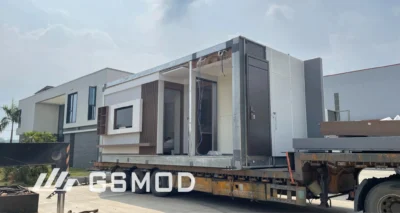
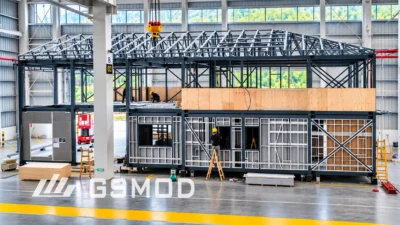
An early announcement may use broad modular or off-site language even when the primary structural frame is site-built and only selected elements – such as bathroom pods or MEP assemblies – are prefabricated. Another project may use complete volumetric modules that form the building structure and enclosure. Both may appear under the same broad label.
For that reason, the first rule of reading modular construction project announcements is simple: do not treat the headline as a technical specification.
Look for What Actually Leaves the Factory
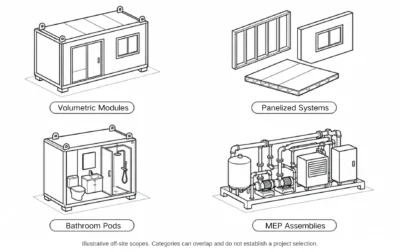
A useful starting question when identifying the construction system is: what is fabricated off site and delivered to the project?
- Volumetric modular units(3D modules)
- Prefabricated bathroom pods
- Kitchen pods
- Wall panels
- Floor cassettes
- Roof panels or trusses
- MEP skids, racks, or plant modules
- Precast concrete components
- Mass timber panels or modules
These terms point to different industrialized construction project types and different scopes. A project using prefabricated wall panels is not the same as a project using load-bearing volumetric modules. A project using bathroom pods may still be a conventional site-built building with a prefabricated wet area.
If the announcement only says “modular construction” but the scope describes a site-built structural frame, you need to verify what role modularization actually plays. Is it the primary structure, the enclosure, the interior fit-out, or only selected components?
Check What Is Assembled and What Carries Loads
Modular construction is often discussed as an assembly method, but structural behavior is separate. You need to know what is assembled and what carries loads.
- Does the module carry gravity loads?
- Does it participate in the lateral-force-resisting system?
- Is there a separate primary structural frame?
- Are module-to-module connections structural?
- How do modules connect to the foundation?
- Is the module a building component or part of the building structure?
A volumetric module may form part of the gravity-load-resisting system, the lateral-force-resisting system, both, or neither, depending on the structural design. A bathroom pod may be non-structural and supported by the building frame. A panelized wall system may be load-bearing or non-load-bearing depending on the design.
Correctly identifying the construction system and its structural role matters for code review, engineering responsibility, inspection, fire-resistance detailing, acoustics, and seismic design. Where modules participate in the building structure, the design documents should clearly define the structural load path, module-to-module connections, the lateral-force-resisting system, foundation connections, and the responsible design parties in accordance with the applicable codes and approval process.
Separate a Possible Method from a Required Method
Procurement language often creates confusion between what is allowed and what is required.
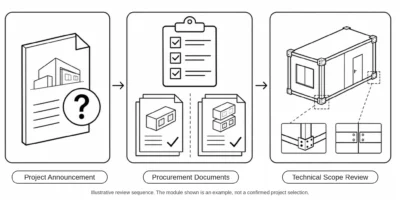
An announcement may say modular construction “may be considered,” “will be evaluated,” or “is permitted as an alternative.” That means modular construction is being considered or allowed. It does not mean the owner has selected volumetric modular construction.
Other announcements are more direct. They may state that the project “shall use volumetric modular units,” “will be delivered as permanent modular construction,” or “requires factory-built modules.” That indicates a stated requirement or intended delivery method, subject to confirmation in the controlling project documents. These phrases do not, on their own, establish that a heavy-steel volumetric system has been selected.
Check the document type. An early project announcement may be exploratory. An RFQ, when used as a Request for Qualifications, may be used to identify or shortlist qualified teams before a later procurement stage. An RFP may define technical requirements, evaluation criteria, and proposal requirements. As the procurement process advances, rely on the controlling procurement and contract documents, including any addenda and stated order-of-precedence provisions, rather than the headline or early project summary. If later documents define the module type, scope, performance requirements, or interfaces more precisely, those details should guide the classification. In other contexts, RFQ may mean Request for Quotation, so use the definition in the document itself.
Record What Is Confirmed and What Remains Unknown
When the construction system is unclear, do not fill the gap with assumptions. Record what the announcement actually says.
- Exact language used to describe modular or prefabricated scope
- Source document and date
- What is confirmed as factory-built
- What is confirmed as site-built
- Structural material, if stated
- Module or panel dimensions, if stated
- Structural role, if stated
- Connections and interfaces, if stated
- Required standards, certifications, or inspections
- Responsibility for design, fabrication, transport, and installation
- Open questions and ambiguities
This record helps you avoid bidding or planning around a construction system the owner has not actually selected. It also gives you a clear basis for requests for information or clarification.
Use the Classification to Ask the Next Project Question
Once you classify the likely system, your next questions become more precise.
Depending on the project, if it appears to use volumetric modules, the next round of clarification may include transport, lifting, module connections, factory inspection, delivery tolerances, and site interfaces.
If it appears to be panelized, ask about panel joints, lifting and sequencing, structural connections, weather enclosure, and interface with site-built work.
If it appears to be pods or MEP modules, ask about rough-in coordination, structural support, code approvals, and responsibility for final connections.
If it is a hybrid system, ask who is responsible for structural design at each interface and how loads are transferred between factory-built and site-built systems.
The classification is not the final answer. It is the tool that helps you ask the right next question.
FAQ
Does a modular project announcement prove that 3D modules will be used?
No. The word “modular” in an announcement may be used broadly. It does not by itself confirm that three-dimensional modules will be used. To confirm 3D modules, look for language such as “volumetric modular units,” “three-dimensional modules,” or “complete room modules,” and verify the scope in the specifications.
Does permanent modular mean steel volumetric construction?
No. “Permanent modular construction” describes a building delivery approach in which permanent building sections or modules are manufactured off site and assembled at a fixed project location. It does not specify a single structural material. Permanent modular buildings may use steel, wood, concrete, or hybrid structural systems.
However, the phrase should not automatically be treated as a synonym for panelized construction or other prefabricated component systems. If the project documents are unclear, verify whether they describe volumetric modules, panels, pods, or another off-site system.
What should be recorded when the construction system is unclear?
Record the exact language from the announcement, the document type and date, what is stated as factory-built, what is stated as site-built, any structural material or load-bearing information, required standards, and the responsibilities assigned to each party. Then list the unanswered questions. Do not assume a construction system simply because the word “modular” appears.
Conclusion
Reading a modular construction project announcement in North America is an exercise in classification. The headline may signal that some form of modular or off-site construction is being considered, but it does not establish the technical system.
Focus on what leaves the factory, what is assembled, what carries loads, and whether modular construction is allowed or required. Record what is confirmed, mark what is unknown, and use that classification to ask better questions. That is how you identify a modular construction system from an announcement without overreading the label.
Discuss Your Project Scope
Have a project announcement that uses “modular” but does not define the system? Share the public notice, RFQ/RFP excerpt, or scope summary with GSMOD for an initial technical discussion about whether the project appears to describe volumetric modular construction.
Discuss your project scope with GSMOD
This is an initial scope discussion, not legal, procurement, engineering, or code advice.
How This Guide Was Prepared
This guide combines GSMOD’s international volumetric modular project-scoping and technical-coordination experience with selected ICC/MBI off-site construction standards and selected public procurement guidance from the United States and Canada. It is intended to help readers interpret project-announcement language, not to provide project-specific legal, procurement, engineering or code advice. Terminology, approval pathways, procurement procedures and document precedence vary by jurisdiction and contracting authority. Always rely on the controlling project documents and qualified local professionals for project-specific decisions.
Content reviewed against the selected references below in October 2026.
Technical References
- ICC/MBI 1200-2021, Standard for Off-site Construction: Planning, Design, Fabrication and Assembly
- ICC/MBI 1205-2021, Standard for Off-site Construction: Inspection and Regulatory Compliance
- ICC/MBI 1210-2023, Standard for Mechanical, Electrical, Plumbing Systems, Energy Efficiency and Water Conservation in Off-site Construction
- Modular Building Institute, Relocatable Buildings vs. Permanent Modular Construction: What’s the Difference?
- U.S. Federal Highway Administration, Current Design-Build Practices for Transportation Projects: Procurement Process
- Infrastructure Ontario, FAQs: Public Private Partnerships (P3s)

Mont Duan
Experienced in modular building engineering, technical design and construction solutions, with a focus on delivering efficient and reliable modular building projects.