

South Korea’s modular construction market reached USD 1.80 billion in 2025 and is projected to grow at a CAGR of 4.90% through 2035, driven by labour shortages, government housing support, and plans to expand modular public rental housing orders to 3,000 units by 2026. This guide covers the ten Korean companies with the strongest demonstrated modular building credentials in 2026.
Evaluation Criteria for Ranking
Companies are ranked based on the following criteria:
- Dedicated modular manufacturing or R&D capability
- Project scale and complexity achieved
- Certifications and international reach
- Modular-specific track record and demonstrated system
- Market prominence in modular building applications
General construction companies are included only where their modular division has a demonstrable, dedicated system or product line. Companies serving modular education buildings, residential, and industrial sectors are all considered.

Top 10 Korean Modular Building Companies
| Company | Modular System | Primary Focus |
| Hyundai Engineering | H-Modular Lab | High-rise permanent modular |
| Samsung C&T | Proprietary | Large-scale housing, international |
| GS E&C | XiGEIST / GPC | Timber + concrete modular |
| POSCO A&C | MUTO / INNOHIVE | Steel modular, international exports |
| PLANM Co., Ltd. | Green modular | Dedicated modular specialist |
| NRB Inc. | Steel + PC modular | Relocatable and permanent modular |
| Space Factory | Automated timber | Residential timber modular |
| DL E&C | Prefab systems | Multi-sector construction |
| Lotte E&C | Prefab systems | Urban residential |
| Hanwha E&C Division | Proprietary | Large-scale modular housing |
1. Hyundai Engineering
Hyundai Engineering Co., Ltd. is South Korea’s most prominent name in high-rise modular construction. Together with Hyundai Steel, the company established H-Modular Lab—a dedicated modular R&D and delivery division that completed the country’s tallest modular housing development in 2023: the 13-story Yongin Yeongdeok Gyeonggi Happy Housing project. With the government targeting 3,000 modular public housing units annually from 2026, Hyundai Engineering is positioned at the center of Korea’s modular housing pipeline.
Website: https://eng.hdeng.co.kr/
2. Samsung C&T
Samsung C&T is South Korea’s largest construction company by revenue and has made substantive modular investments across domestic and international markets. The company secured modular housing contracts for NEOM workers in Saudi Arabia, formed a technology partnership with a Latvian modular construction firm to advance factory-built construction globally, and in 2023 signed a collaboration with Indonesia’s largest property developer to integrate modular and renewable energy into smart city projects. Samsung C&T’s scale, international network, and access to Samsung Group supply chains give it a strong international reach in modular construction.
Website: https://www.samsungcnt.com/eng/
3. GS E&C
GS Engineering & Construction has invested in modular through two parallel systems. XiGEIST, a dedicated wooden modular subsidiary, develops timber-frame residential and mixed-use buildings. The GPC (GS Prefab Concrete) system applies precast concrete modular units to urban apartment construction. In May 2025, GS E&C completed a demonstration of its prefabricated concrete apartment system—documented publicly as evidence of large-scale precast modular viability in the Korean market. GS E&C’s dual-material approach is unusual among Korean contractors and positions the company to serve both the timber residential segment and the high-density concrete apartment market.
Website: https://www.gsec.co.kr/eng/
4. POSCO A&C
POSCO A&C is one of South Korea’s longest-established dedicated modular manufacturers and an active member of the Modular Building Institute (MBI), where its INNOHIVE system has received MBI Awards of Distinction. Its MUTO and INNOHIVE systems have supported steel modular projects in Korea and overseas, including dormitory and industrial-use modular buildings.
The INNOHIVE system applies standardised factory-fabricated steel modules across building types, reducing construction periods by up to 50% and enabling high reuse of structural elements at the end of life. POSCO A&C operates a dedicated modular manufacturing plant in Cheonan, South Chungcheong Province.
Website: https://www.poscoanc.com/en/
5. PLANM Co., Ltd.
PLANM is Korea’s most focused pure-play modular construction company. Founded in 2020 and headquartered in Eumseong, Chungcheongbuk-do, the company operates a 160,000-square-meter production facility capable of over 10,000 modules per year—covering modular schools, medical facilities, residential buildings, mobile laboratories, and leisure structures.
PLANM has supplied 150 school modules to education offices across Korea and also operates PLANM GLOBAL LIMITED in London, UK.
Website: https://planm.kr/en/
6. NRB Inc.
NRB Incorporated is South Korea’s first company specialising in Relocatable Buildings and owns the largest domestic modular single factory, producing steel frame and PC (Precast Concrete) modular units simultaneously. The company listed on the Korean stock exchange in July 2025 and presented the 22-story Uiwang PC modular apartment project with LH in April 2025, the tallest modular residential building in Korea. NRB is approved for modular application in buildings up to 30 stories—Korea’s highest certification level—and its Bridge School product has won the Red Dot Design Award and IDEA Award.
Website: https://www.and-rb.com/eng/
7. Space Factory
Founded in 2004 under the name Hangulhousing and based in Gyeonggi Province, Space Factory is South Korea’s national market leader in modular timber residential construction. The company focuses on two- and three-story homes in suburban and rural locations, having transitioned from traditional stick framing to fully automated modular production.
Space Factory’s facility uses HOMAG machinery and targets a production capacity of 1,000 homes per year, with national delivery coverage across South Korea. Its automated production capability is distinctive in a domestic market that has historically relied on labour-intensive on-site methods.
Website: spacefactory.co.kr
8. DL E&C
DL E&C (formerly Daelim Industrial, rebranded in 2021) is one of South Korea’s major contractors with growing integration of prefabricated and modular methods across residential, industrial, and overseas EPC projects. The company has been adopting modular construction to address Korea’s labour shortage and schedule requirements, with prefabricated housing and wood-based modular systems among its active development areas.
Website: https://dlenc.co.kr
9. Lotte E&C
Lotte Engineering & Construction has been expanding its PC modular and off-site construction (OSC) capabilities across urban residential and mixed-use developments, backed by OSC-related patents and in response to government modular housing targets. Lotte E&C’s modular activities are concentrated in the Korean domestic market with increasing investment in industrialised construction methods for high-density Seoul metropolitan projects.
Website: https://www.lottecon.co.kr/eng/
10. Hanwha Corporation E&C Division
Hanwha Corporation’s Engineering & Construction Division is delivering one of the largest factory-built and precast housing programmes globally—100,080 residential units in Iraq by 2030, with more than 30,000 completed and over 21,000 occupied by end of 2024. The scale of the Iraq programme demonstrates industrialised construction at a level few Korean or global contractors can match. Domestically, Hanwha E&C integrates modular and prefabricated methods into its construction delivery alongside large-scale commercial and infrastructure projects.
Website: https://www.hanwha.com/companies/hanwha-corporation-e-c-division.do
GS Modular: Steel Modular Integrated Construction
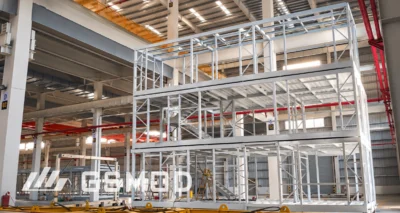
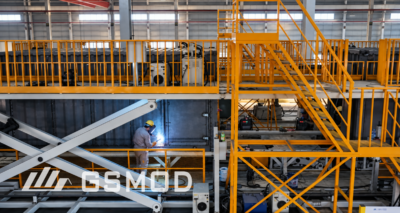
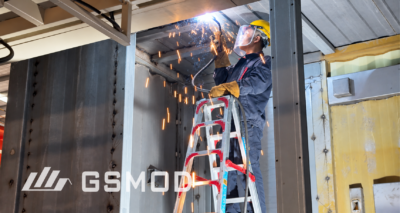
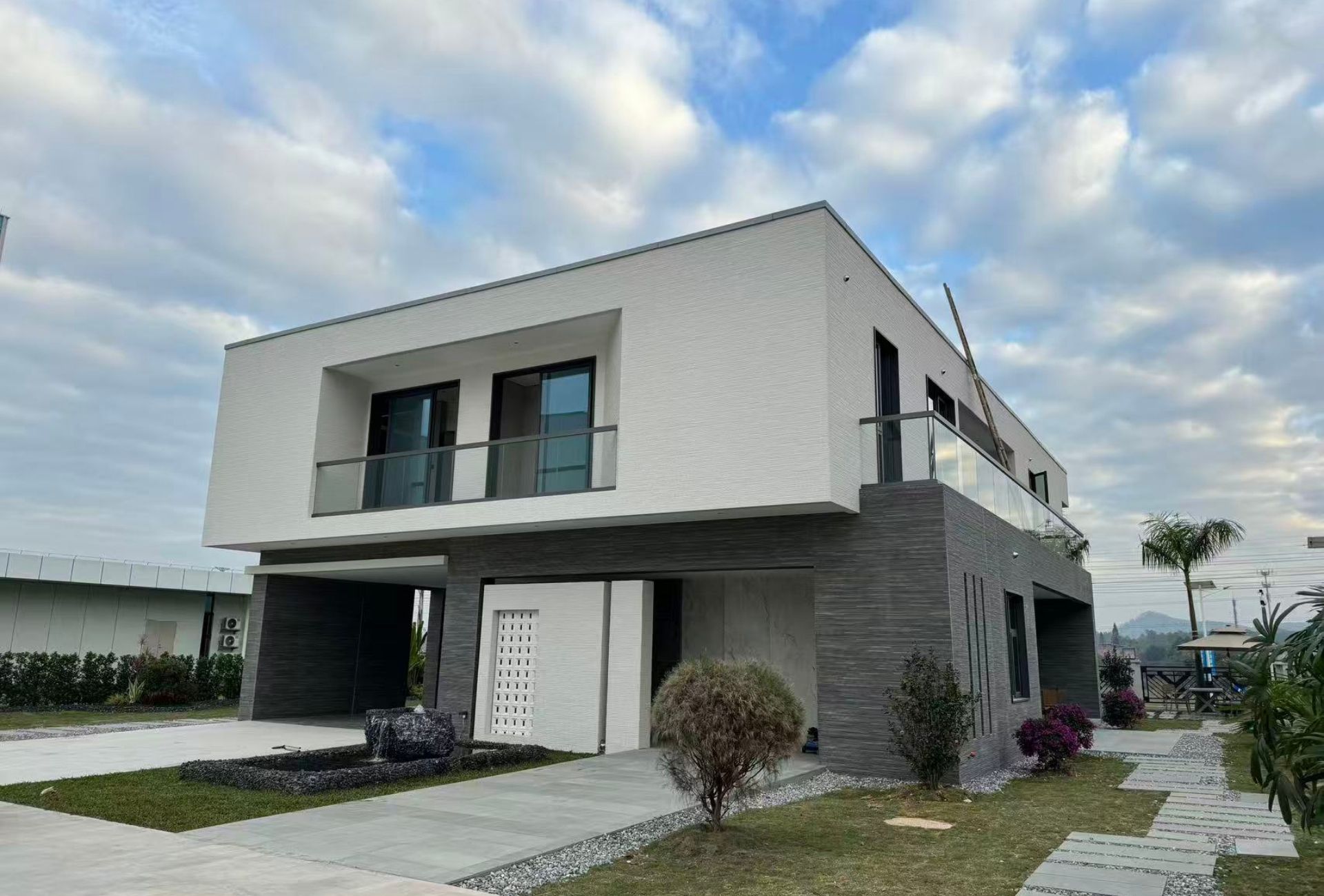
GS Modular manufactures permanent steel modular construction systems—factory-prefabricated steel frame modules for residential, hospitality, educational, and industrial applications—from a 70,000-square-meter production base in Foshan, China. With over 25 years of manufacturing experience and an annual production capacity exceeding 10,000 units, the company combines engineering precision with standardised production to deliver consistent quality at scale. GS Modular holds ISO 9001, ISO 14001, and ISO 45001 certifications and delivers custom modular solutions to projects across more than 25 international markets.
Conclusion
Korea’s modular market splits between large chaebols—Hyundai Engineering, Samsung C&T, GS E&C—scaling modular for government housing programs, and dedicated specialists like POSCO A&C and PLANM building modular-first operations with proprietary systems and dedicated factories. GS Modular offers an international steel modular manufacturing option for projects outside the Korean domestic market.