

Hotel development is evolving as developers face rising construction costs, labour constraints, tighter timelines and increasing demand for delivery certainty. Against this backdrop, many developers are reassessing conventional methods and considering off-site delivery strategies. Selecting the right modular hotel builder is an important consideration when adopting this approach. This guide provides a balanced comparison of modular and traditional hotel construction across timeline, cost, quality, site impact, design flexibility and application suitability.
Understanding Modular Hotel Construction
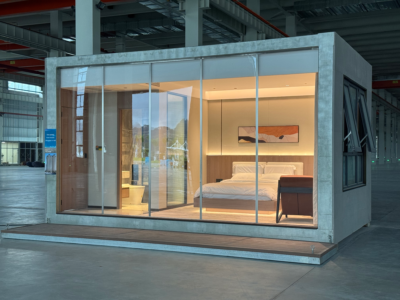
Modular hotel construction involves manufacturing three-dimensional building units off-site in a factory environment, then transporting them to the project site for assembly.
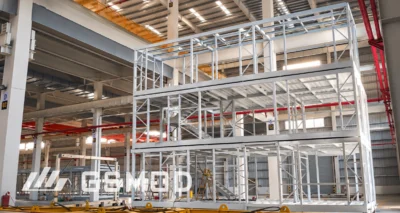
Factory-built modules typically include structural framing, finishes, building services, fixtures and interior fittings before leaving the factory. Common hotel modules include guest rooms, bathrooms, corridors and other repetitive spaces. Mechanical, electrical and plumbing (MEP) systems can be pre-installed and tested within modules, with final inter-module connections completed on-site.
The modular delivery process is characterised by parallel workflows: factory fabrication and site preparation (foundations, utilities, podium works) proceed simultaneously. The process typically includes design coordination, factory production, transport, installation and final site connections.
How Traditional Hotel Construction Works
Traditional hotel construction follows a linear, sequential approach: design, engineering, procurement, and on-site construction occur in phases, each dependent on completion of the previous.
All building work—substructure through superstructure, internal finishes, and building services—is carried out on location. Skilled trades work sequentially in situ. This approach allows design changes during construction but exposes projects to weather conditions, local labour market fluctuations, and site-specific variability.
Modular Hotels vs Traditional Hotels: Key Differences
| Aspect | Modular Construction | Traditional Construction |
| Timeline | Parallel factory and site work can shorten overall programmes for suitable projects. | Sequential process; site work must complete before finishes can begin. |
| Cost | Higher initial module costs may be offset by reduced on-site labour, less waste and shorter programmes. | Lower unit costs but higher site labour, material waste and weather-related delay risk. |
| Quality Control | Factory-controlled environments enable consistent production and defect identification before dispatch. | Quality depends on local trades, supervision and weather; greater variability possible. |
| Site Impact | Shifts substantial work off-site, reducing site activity, noise, dust and construction traffic. | Extended site presence with more workers, deliveries and on-site activity. |
| Design Flexibility | Requires early design freeze; transport dimensions limit module geometry. | Greater flexibility for late-stage changes and complex architectural forms. |
Key Factors That Determine the Right Construction Approach
Rather than assuming one method is superior, developers should evaluate these factors:
Project location – remoteness, transport access, local labour availability, weather conditions.
Building complexity – irregular geometry, large spans, special architectural features.
Design repetition – number of identical room layouts; higher repetition favours modular.
Required delivery timeline – urgency of opening and market windows.
Site accessibility – constraints for crane positioning, module delivery and on-site manoeuvring.
Customisation requirements – degree of bespoke finishes, layouts and brand identity elements.
A project-specific feasibility study, including cost-benefit and risk analysis, is recommended before committing to either approach.
Modular Hotel Timeline and Cost Considerations
Modular Hotel Timeline
Modular allows foundation works and module fabrication to occur concurrently, whereas traditional builds must complete structural works before internal finishes. Installation of modules is typically rapid—often a matter of days for a medium-sized hotel—provided that site preparation, crane logistics and module delivery are well coordinated. However, overall programme depends on factory lead times, transport schedules and final connection efficiency.
Modular Hotel Cost
Initial module manufacturing costs may be higher than site-built equivalents due to factory overheads, tooling and transport. These costs can be offset by reduced on-site labour, lower material waste and fewer weather delays. Whole-life cost factors include:
Financing costs – shorter construction periods reduce interest during construction.
Maintenance – factory quality-control processes may reduce defects and rectification work.
Energy performance – modular construction can achieve good airtightness and thermal insulation performance.
Adaptability – modules may be relocated or repurposed, offering future flexibility.
Modular economics improve with higher unit repetition and standardised layouts. The economic case becomes stronger when projects have sufficient scale, repetition and favourable delivery conditions.
Which Hotel Projects Are Suitable for Modular Construction?
Resort Hotels – Remote or eco-sensitive locations benefit from reduced on-site footprint. Modules can be transported by sea, road or specialised logistics, minimising disruption.
Remote Hotels – Where local labour and materials are scarce, modular reduces reliance on regional resources. Factory production reduces dependence on local availability, though transport planning remains critical.
Boutique Hotels – Modular systems can support distinctive design through custom cladding, finishes and hybrid layouts when design, manufacturing and installation are carefully coordinated.
Large-Scale Hotel Developments – Branded hotels with repetitive floor plans, such as select-service or extended-stay concepts, are strong candidates. High unit counts enable efficiency through repeat production.
When Traditional Hotel Construction May Be More Suitable
Traditional construction may be more suitable for:
Highly customised architectural projects – designs with unique geometries, large atriums, cantilevers or non-orthogonal forms.
Complex geometries and landmark buildings – where architectural expression is paramount and module dimensions are restrictive.
Irregular sites – steep slopes, odd property lines or existing structures requiring bespoke on-site solutions.
Projects with frequent late-stage changes – where design evolution is expected during construction.
Sites with strict height or footprint limits – modular adds duplicated walls and floor/ceiling assemblies, increasing overall height and bulk.
In these cases, the flexibility of site-built construction often outweighs the programme advantages of modular.
Choosing the Right Modular Hotel Builder
Not all modular hotel builders are equally suited to hospitality projects. Builders specialising in hotels must address specific requirements beyond standard residential or commercial modules.
Key capabilities to evaluate:
Hospitality project experience – understanding of brand standards, guest comfort criteria and operational workflows.
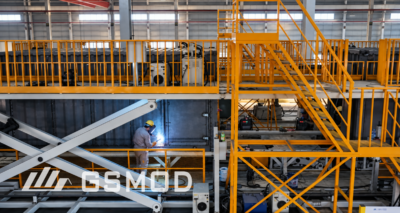
Manufacturing capability – capacity for large volumes of consistent, high-finish modules with tight tolerances.
Engineering and BIM capability – ability to handle complex structural, acoustic and MEP integrations; Building Information Modelling (BIM) for coordination and clash detection.
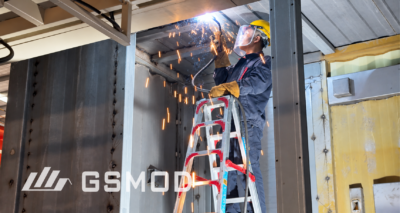
Quality management systems – robust inspection and testing regimes ensuring factory-completed elements meet design specifications.
Logistics and installation support – expertise in transport, crane-lift planning and on-site integration to minimise programme risk.
Assessment methods:
Request project case studies and speak with previous clients.
Conduct factory visits to observe production lines and inspect sample modules.
Review quality documentation and defect rectification procedures.
Selecting a builder with these capabilities is essential to realising the potential benefits of modular construction.
Conclusion
Choosing between modular and traditional hotel construction is not about declaring one universally superior. Modular may offer advantages when speed, repeatability and reduced site impact are key priorities—particularly for resort, remote and large-scale hospitality projects with repeatable layouts. Traditional construction remains highly suitable for custom architectural designs, complex sites and projects where design flexibility is critical.
Each project requires careful evaluation of its specific conditions: location, programme, budget, design intent and risk profile. By understanding the strengths and limitations of both approaches, developers can make informed decisions aligned with their strategic objectives.
The goal is not to choose the “best” method in absolute terms, but to select the approach that best fits the unique demands of each hotel development.
FAQ
What are the main benefits of modular hotel construction?
Key benefits include potentially shorter programmes, more controlled production conditions, reduced on-site activity and improved delivery predictability. These advantages are most significant for projects with high design repetition and suitable site conditions.
Are modular hotels cheaper than traditional hotels?
Initial module costs may be higher, but total project costs may be reduced considering less site labour, reduced waste and shorter programmes. Cost advantage depends on project scale, location and time sensitivity—project-specific analysis is essential.
How long does modular hotel construction take?
Modular can shorten delivery for suitable projects, but programmes vary. On-site installation is typically fast, though total duration depends on factory lead times, transport, site preparation and final connections.
What projects are suitable for modular construction?
Resort hotels, remote hotels, boutique hotels and large-scale branded hotels with repetitive layouts are strong candidates. Suitability depends on design repetition, site accessibility, timeline requirements and transport conditions.
How should developers choose a modular hotel builder?
Evaluate hospitality experience, manufacturing capability, engineering and BIM resources, quality systems and logistics support. Conduct factory visits, review case studies and speak with previous clients.