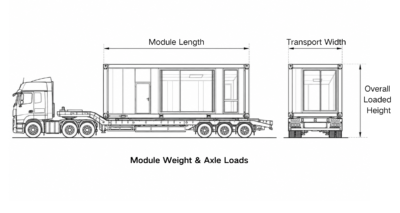


In volumetric modular construction, modules are manufactured off site with varying levels of finishes and building services before being transported to the project site for installation. There is no single universal maximum size for a volumetric module. A module’s practical size is determined by manufacturing capability, transport regulations, route geometry, transport equipment, lifting requirements, and site access. A factory may be capable of producing modules that are larger than a particular route, lifting plan, or site can accommodate. Factory capability is therefore only one part of the module-size envelope. Transport, lifting, and site-access constraints can become equally important—or more restrictive—than factory capability before the module reaches its final position. [R1]
Understanding those limits early is essential. If the design team freezes a floor plan before checking transport constraints, the project can face costly redesign, permitting or routing delays, changes to the module split, or additional site-completed scope.
Module Size Is Not the Same as Building Size
A common misunderstanding is to confuse the size of a building with the size of its modules. A building can be very large. It can be hundreds of feet long and many stories high. But that building is assembled from individual volumetric modules, and each of those modules must travel separately.
Building size and module size are different design questions. A building may be large, while each transportable module must fit within the combined limits of manufacturing, transport, lifting and site access. A project may have a building footprint that is entirely feasible, yet the individual modules must be split into smaller units to move safely and legally. In other words, a large building may still need to be divided into much smaller transportable modules.
Why There Is No Single Maximum Module Size
Several different factors can limit module size, and the controlling factor can change from one project to another.
| Factor | Why it matters |
| Manufacturing | Factories have different fabrication and handling capabilities. |
| Transport regulations | Permitted dimensions and weight vary by jurisdiction. |
| Route | Roads, turns, bridges and clearances differ by project. |
| Lifting | Crane capacity depends on the required setup and reach. |
| Site access | Final-mile access, staging and installation space can be more restrictive than the main route. |
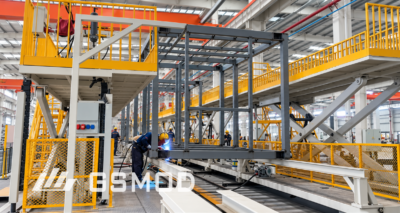
Factory fabrication of a steel-framed building module. Manufacturing and handling capabilities are only part of the practical module-size equation.
The most restrictive condition may differ from project to project, and the commercially sensible module size may be smaller than the physical maximum.
For an overview of the delivery stages, see GSMOD’s modular manufacturing and delivery process.
Four Transport Constraints: Width, Height, Length and Weight
Every volumetric module must be evaluated across four transport parameters: width, height, length, and weight. Each one creates a different set of constraints.
Width and height
Width is a major transport constraint. Highway lanes, bridge clearances, toll plazas, and local roads all impose practical limits. Depending on the jurisdiction and load dimensions, oversize permits, pilot/escort vehicles, route restrictions, or law-enforcement escorts may be required. Increasing width can trigger additional permitting, escort, routing or equipment requirements, which may materially change transport cost and complexity. [R3]
Height is another major transport constraint. Overpasses, tunnels, utility lines, and traffic signals create vertical clearance limits. A small increase in transport height can eliminate an otherwise preferred route, trigger a detour, or require additional utility and clearance coordination. In some cases, no feasible route may be available without changing the transport strategy, route, or module design.
Length and weight
Length affects maneuverability, swept-path requirements and trailer configuration. A long module can be difficult to turn through intersections, navigate around tight corners, or position at the site. It also affects the trailer type and whether an extendable trailer is needed.
Weight is another critical constraint. A module with factory-installed finishes, fixtures, and building services can become substantially heavier as factory scope increases. Bridges have load ratings. Roads have axle weight limits. Weight and load distribution influence axle configuration and allowable routing. Available crane capacity depends on the selected crane configuration and operating radius. A module that is too heavy for the selected crane at the required operating radius may force a change in crane selection, setup, or module strategy.
Why the Route Can Change a Module Design
The route from the factory to the site is not just a path. It is a design constraint. Two projects with identical modules can have different maximum sizes if one site is accessed by a wide industrial road and the other is accessed through a historic downtown with narrow streets and low trees.
Turns and overhead clearance
Tight turns, roundabouts, and narrow intersections limit how long and wide a module can be. Overhead clearance limits how tall it can be. In some cases, the route may require coordination with local authorities or utility owners for temporary clearance measures, where permitted. Those measures can require additional permitting, cost, and coordination.
Bridges and access restrictions
Bridges may impose load restrictions, while bridge openings and underpasses can limit vertical clearance. A route that looks fine on a map may have a bridge that cannot carry the load or an underpass that is too low. Road and route restrictions may also vary seasonally in some jurisdictions. [R2]
Final-Mile Site Access
Final-mile access can become one of the most restrictive parts of the delivery route. The site entrance may be narrow. There may be fences, gates, trees, or utility poles. The ground may not support the weight of the transport vehicle or the crane. The site may not have enough space to stage modules before lifting. These factors may require a smaller module, a different module split, or changes to the site logistics plan even when the main highway route is feasible.
Why Bigger Modules Are Not Always the Better Choice
It is tempting to assume that bigger modules are always more efficient. Larger modules may reduce module count, lifting cycles, and some module-to-module connections. That can reduce certain types of site work, but only up to a point.
Transport cost and complexity can increase as module dimensions or weight cross permitting, escort, routing, or equipment thresholds. Oversize permits, escort vehicles, route surveys, and specialized trailers all add expense. Larger modules may require a different or higher-capacity crane, potentially increasing mobilization and operating costs. They may also require temporary road closures or night moves. The site may also require upgraded temporary access routes, engineered working platforms, crane mats, or a larger staging area.
The economically optimal module size may be smaller than the physical maximum. The goal is not to build the biggest module possible. The goal is to find the size that optimizes total project cost, schedule, transportability, installation efficiency and risk.
Why the Crane and Site Matter Too
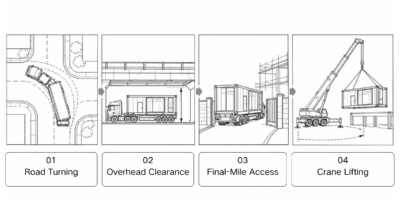
Conceptual illustration of the transport-route and installation constraints that can limit practical volumetric module dimensions.
The crane is a critical part of the module size equation. Available lifting capacity depends on the crane configuration and operating radius. A module that can be transported may still exceed the capacity of the selected crane at the required operating radius, forcing a change in crane selection, setup, or module strategy. The lifting points on the module must also be designed to handle the load without damaging the structure. [R4]
The site itself matters just as much. Site geometry, available setup space, and final-mile access can all affect whether a module can be installed as planned. In other words, transport feasibility does not automatically equal installation feasibility.
For system information, see GSMOD’s modular lifting and installation.
Why Transport Constraints Need to Be Considered Early
Transport constraints should be considered before the module layout is frozen. Route, lifting and final-mile access can all change the module split and layout, so they should be treated as early design inputs rather than checked only after production planning begins. More detailed route, lifting and installation validation depends on the specific project and jurisdiction.
When transport constraints are checked early, the project can reduce late redesign, permitting uncertainty, logistics risk, and schedule disruption. If these constraints are not resolved early, the project may reach production with a module configuration that cannot be delivered as planned, leading to redesign, logistics changes, or schedule and cost impacts.
FAQ
Is there one maximum size for a volumetric module?
No. There is no single maximum size that applies everywhere. The limit depends on the specific route, the jurisdiction’s transport regulations, the crane capacity, and the site conditions. A module that is legal and feasible for one project may be impractical or infeasible for another.
Can route and site access change a modular floor plan?
Yes. Route and site access can change a modular floor plan. If a module’s dimensions or weight exceed what the route, transport equipment, lifting plan, or site access can accommodate, the module split may need to be revised, or the internal layout may need to change. In some cases, additional scope may need to be completed on site.
Does a larger module always reduce total project work?
No. A larger module may reduce module count and some on-site connections, but it may increase transport complexity, permitting requirements, crane requirements, and site logistics. Reducing module count does not necessarily reduce total project cost, because transport, lifting, permitting, and site-logistics requirements may increase. The optimal size is the one that balances factory efficiency, transport feasibility, and site installation.
Why can the same module size work on one project but not another?
Because module feasibility depends on the specific route, transport regulations, lifting conditions and site access. A module that can be manufactured and delivered to one site may require a different transport strategy, module split or installation approach on another project.
Can a module be transportable but still too large to install on site?
Yes. Transport feasibility does not automatically mean installation feasibility. A module may be able to travel legally to the project area but still be difficult to move through the final site entrance, position in the crane pick zone, or lift at the required operating radius. Crane capacity, ground bearing conditions, staging space, and site geometry therefore need to be checked alongside the transport route.
A volumetric module’s practical size is defined by the combined limits of manufacturing, transport regulations, route geometry, transport equipment, lifting strategy and site access. By understanding those limits early and designing within them, project teams can select module dimensions that are better aligned with manufacturing, transport, lifting, installation, cost, and schedule requirements.
How This Guide Was Prepared
This guide draws on published industry guidance on modular transportation and oversize-load planning, together with technical input from GSMOD’s heavy-steel volumetric modular team. It explains why practical module size varies by project. Detailed transport, lifting and permitting requirements depend on the project and jurisdiction and should be confirmed with the relevant engineers, carriers, contractors and authorities.
The U.S. sources below support general transport and lifting principles; they do not establish rules for every jurisdiction.
Technical References
R1 Modular Building Institute — Inside the Modular Building Process
R2 Federal Highway Administration — Pilot/Escort Vehicle Operators Training Manual — Module 3 Route Planning
R3 Federal Highway Administration — Pilot/Escort Vehicle Operators Best Practices Guidelines — III Load Movement
R4 Occupational Safety and Health Administration — 29 CFR 1926.1417 Operation
Sources last reviewed on October 8, 2026.
Related Reading
Modular Office Budget: 8 Cost Risks to Plan Early
Modular Lifting & Installation System
Discuss Your Project
Planning a permanent heavy-steel volumetric modular project? Share your project location and intended use with GSMOD to discuss how manufacturing, transport and installation requirements may affect the module strategy.

Mont Duan
Experienced in modular building engineering, technical design and construction solutions, with a focus on delivering efficient and reliable modular building projects.