





Introduction
This guide explains how compliance is demonstrated and how approval is obtained for modular office buildings in Australia. It covers Evidence of Suitability, factory documentation, state and territory adoption, approval pathways, and project QA processes. Technical design requirements are addressed separately.
The applicable NCC technical requirements for a modular office do not change because modules are manufactured off site. However, the evidence, inspection and certification arrangements may differ from conventional construction.
For the full technical compliance requirements, see the guide on NCC Class 5 modular office technical compliance requirements in Australia.
Why Off-site Manufacturing Changes the Evidence Strategy
In conventional construction, the certifier inspects work progressively on site. With modular construction, most work is completed in a factory before the modules arrive in Australia. Some completed or concealed work may no longer be accessible once modules arrive on site. This means that factory QA/QC records, pre-dispatch inspections and independent testing reports become more important than in conventional construction.
Project teams should establish an evidence and inspection strategy early. Evidence of Suitability, factory QA/QC records, test reports and agreed inspection arrangements may be used together to support compliance assessment, subject to the relevant jurisdiction and certifier requirements.
Evidence of Suitability Under NCC Part A5
Evidence of Suitability (EoS) is defined in NCC Volume One, Part A5. It establishes the acceptable forms of evidence that a building product, material, or construction system meets the relevant NCC Performance Requirements. NCC Part A5 recognises several forms of Evidence of Suitability, summarised below.
| Evidence Type | Description | Notes |
| CodeMark Certificate | Certificate of conformity under the CodeMark scheme | Recognised evidence for products or systems within its scope; does not remove project-specific design, installation or jurisdictional requirements |
| Certificate of Accreditation | Certificate issued by a state/territory accreditation authority | Subject to scope, conditions and acceptance requirements of the issuing authority |
| Certificate from a certification body | Certificate stating properties and performance fulfil specified NCC requirements | Fire resistance, acoustic performance |
| Report from an accredited testing laboratory | From NATA-accredited (or equivalent) laboratories | Material properties, structural capacity |
| Certificate/report from a qualified engineer | From an appropriately qualified practitioner | Structural design certification, fire engineering |
| Other documentary evidence | As accepted under the NCC | Product technical statements, specifications |
Multiple forms of evidence may be used where necessary to demonstrate suitability for the proposed application.
Evidence used to determine the fire resistance of building elements is also subject to the specific NCC provisions dealing with determination of fire resistance.
Evidence of Suitability is one of the key mechanisms used to demonstrate that relevant materials, products, forms of construction or designs meet applicable NCC requirements. Incomplete or poorly coordinated compliance evidence can contribute to approval delays or additional assessment requirements.
What CodeMark and Certificates Can and Cannot Do
A current CodeMark Certificate of Conformity may provide recognised evidence for the products or systems covered by its scope. It does not by itself establish whole-building approval or remove project-specific design, installation, certification or jurisdictional requirements.
Similarly, Certificates of Accreditation and certificates from certification bodies are valuable evidence but must be assessed within their scope, conditions and acceptance requirements.
Factory Manufacturing and Compliance Documentation
Engineering and Shop Drawings
Engineering drawings — certified by an appropriately qualified and registered/licensed structural engineer where required by the relevant jurisdiction — include structural plans, sections, elevations, connection details, and load calculations.
Shop drawings are developed from engineering drawings for factory production, including steel cutting and welding details, module assembly sequences, embedded item locations, and service routing. Shop drawings should be reviewed in accordance with the project’s engineering, design responsibility and QA procedures before production.
Material Certificates and Test Reports
Materials, products and systems requiring compliance evidence should be supported by appropriate certificates, test reports, declarations or other documentation. Examples include:
Steel mill certificates (to AS/NZS standards)
Insulation thermal conductivity test reports
Fire-resisting assemblies or systems with appropriate test/assessment documentation
Structural connection load test reports
Coatings and corrosion protection product certificates
Electrical cable certification
Fire-resisting assemblies or systems requiring compliance evidence should be supported by appropriate test or assessment documentation from an accredited testing body or other evidence acceptable under the applicable NCC provisions. For imported materials, test reports should be from NATA-accredited (or equivalent recognised) laboratories.
QA/QC and Inspection Records

Illustrative image of factory inspection and quality-control activities for modular building projects.
Factory QA/QC records may include:
Incoming material inspection records
Weld inspection records (including NDT reports where applicable)
Module dimensional accuracy checks
Embedded item position and level checks
Concealed works inspection records (services rough-in, fire-stopping)
Controlled production conditions can support repeatable inspection, traceability and dimensional control when a documented QA/QC system is implemented.
Evidence of Suitability Documentation
Project-specific compliance evidence may include structural, fire, acoustic, thermal, services and factory QA records. If required evidence is incomplete, the relevant certifier or approval authority may be unable to complete the certification or occupancy process.
Pre-dispatch Inspection Records
Before modules leave the factory, a project QA procedure may include a pre-dispatch inspection:
External visual inspection of the module (no damage, no deformation)
Dimensional re-measurement (length, width, height, diagonals)
Door and window operation
Service connection points — position and condition
Embedded item and connection plate positions
Securing and bracing for transport
This is a manufacturing QA measure rather than a universal NCC-mandated inspection stage. The pre-dispatch inspection should be signed off by the factory QA team and, where required, by the client’s representative or independent inspector.
What Overseas Manufacturers Need to Prepare
Overseas-manufactured modules may be used where the project team can provide the evidence required to demonstrate compliance with the applicable NCC requirements and referenced standards, together with any other relevant Australian building, plumbing, electrical, product and jurisdictional requirements.
Key documentation typically includes:
Structural engineering certification
Fire test reports or assessments
Material certificates to applicable AS/NZS standards
Factory QA/QC records
Evidence of Suitability documentation
The specific requirements depend on the project, jurisdiction and certifier. Early engagement with a building certifier or surveyor is strongly recommended.
Factory Certification Does Not Equal Project Approval
Factory quality certifications (e.g., ISO 9001) cannot replace statutory building approval in Australia. Modular offices still require building approval or permit and occupancy approval or certificate from the relevant authority in the project’s state or territory.
Factory certifications can support Evidence of Suitability but do not replace the approval process.
NCC Adoption by State and Territory
NCC 2025 was published on 1 May 2026. NCC adoption timing and transitional arrangements vary by jurisdiction. Verify the edition in force for the project location at the time of design and approval.
Last verified: August 2026. Users should confirm current adoption dates with the relevant jurisdiction’s building authority before finalising project documentation.
| State/Territory | Current NCC Edition | Notes |
| Australian Capital Territory | Transition: NCC 2022 / NCC 2025 | Certain approvals may use either during the transition; NCC 2025 becomes mandatory from 1 May 2027, subject to transitional provisions |
| New South Wales | NCC 2022 | NCC 2025 expected to apply from 1 May 2027 |
| Northern Territory | NCC 2022 | Currently applying NCC 2022 |
| Queensland | NCC 2022 | NCC 2025 expected to apply from 1 May 2027 |
| South Australia | NCC 2022 (BCA) / NCC 2025 (PCA) | BCA: NCC 2022 until 1 May 2027; PCA: NCC 2025 from 1 May 2026 (staged approach) |
| Tasmania | NCC 2022 currently applies | NCC 2025 expected to apply from 1 May 2027, subject to transitional arrangements |
| Victoria | NCC 2025 | Adopted from 1 May 2026 |
| Western Australia | NCC 2025 | Adopted BCA/NCC 2025 provisions from 1 May 2026 |
Each jurisdiction may also apply state-specific variations. Projects must be assessed against the NCC edition and variations actually in force in the project’s state or territory.
Planning, Building and Certification Pathways
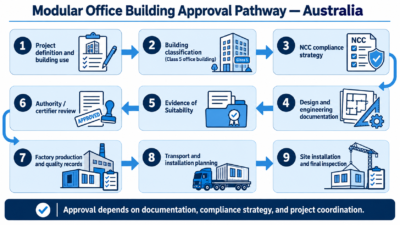
Class 5 modular office projects require approvals. Terminology, responsible authorities and sequencing vary by state and territory. State-specific terms should appear only in clearly labelled examples.
Depending on the project and jurisdiction, the approval pathway may involve planning approval, building approval or permit, inspections and occupancy certification.
- Planning approval— Where required, planning approval is obtained from the local council or state planning authority. Assesses whether the development complies with land use zoning, building height limits, floor space ratios, and urban design requirements.
- Building approval or permit— Building approval or permit is issued or administered by the relevant approval authority, certifier or building surveyor, depending on the jurisdiction. Assesses whether the building design and construction comply with NCC technical requirements. Where building approval or a building permit is required, it generally must be obtained before the regulated building work commences. For modular office projects, approval documentation may include construction drawings, structural calculations, relevant Evidence of Suitability, specialist reports and other project-specific documents required by the relevant authority or certifier.
- Inspection and certification— The relevant building certifier/surveyor or approval authority conducts prescribed or required inspections, as applicable in the relevant jurisdiction, throughout construction and installation. For modular projects, inspection points typically include:
Foundation completion (before module installation)
Module installation and connection completion
Fire-stopping completion
Services connection and testing
Final completion inspection
Subject to the applicable jurisdictional process, completion of the required inspections and documentation may lead to the relevant occupancy approval, permit or certificate — the legal document that permits occupation of the building.
When to Engage the Certifier or Building Surveyor
Early engagement with a certifier who has experience with modular construction is strongly recommended. Off-site manufacturing can require a more structured evidence and inspection strategy because some work may no longer be visible once modules arrive on site.
Engaging the certifier at the design stage — not at the point of application — allows compliance issues to be identified and resolved before modules are manufactured.
Approval and Compliance Evidence Checklist
The following checklist focuses on evidence, documentation and approval process items. Technical design items are covered in the separate technical compliance guide.
Before Design / Approval
□ Confirm the applicable NCC edition for the project state/territory
□ Identify the relevant approval authority, certifier or building surveyor for the project jurisdiction
□ Confirm the required approval pathway for the project type and location
□ Agree on the evidence and inspection strategy with the certifier early (especially for off-site work)
Factory Documentation
□ Required engineering certification (structural, fire, etc.)
□ Evidence of Suitability documentation (CodeMark, testing reports, certificates)
□ Material/product evidence to applicable AS/NZS standards
□ Fire test or assessment documentation for fire-resisting assemblies
□ Factory QA/QC records (incoming materials, welding, dimensions, concealed works)
□ Inspection records for work that will not be accessible on site
Before Dispatch
□ Required compliance package compiled and reviewed
□ Agreed inspections and witness points completed
□ Outstanding non-conformance reports (NCRs) closed or addressed
□ Pre-dispatch QA inspection completed (where applicable)
Installation / Completion
□ Required on-site inspections completed
□ Site connection and services testing records documented
□ Final compliance evidence submitted to the relevant authority/certifier
□ Occupancy documentation completed and submitted
FAQ
How is modular office approval different from traditional construction?
The NCC technical requirements are the same. The difference is that off-site manufacturing can require a more structured evidence and inspection strategy because some work may be concealed before site arrival. Evidence of Suitability, factory QA/QC records and pre-dispatch inspections become more important.
What Evidence of Suitability is typically required?
Evidence of Suitability may include CodeMark certificates, Certificates of Accreditation, testing laboratory reports, engineering certificates, and other documentary evidence accepted under the NCC provisions. Multiple forms of evidence may be used where necessary.
Does factory certification replace building approval?
No. Factory quality certifications cannot replace statutory building approval. Modular offices still require building approval and occupancy approval from the relevant authority in the project’s state or territory.
Can overseas-manufactured modules be used in Australian projects?
Overseas-manufactured modules may be used where the project team can provide the evidence required to demonstrate compliance with the applicable NCC requirements and referenced standards, together with any other relevant Australian building, plumbing, electrical, product and jurisdictional requirements.
Does a relocated modular office require new approval?
Relocation commonly requires new site-specific planning, building and certification assessment because site conditions and jurisdictional requirements may differ. The previous occupancy approval or certificate is not automatically valid at the new location.
How do NCC adoption dates vary between states?
NCC adoption timing and transitional arrangements vary by jurisdiction. Projects must be assessed against the NCC edition and variations actually in force in the project’s state or territory. Verify current dates with the relevant jurisdiction’s building authority.
Regulatory Sources and References
National Construction Code 2025, Volume One — Australian Building Codes Board
NCC 2025 state and territory adoption information — Australian Building Codes Board
ABCB Evidence of Suitability Handbook
CodeMark official guidance
Relevant state/territory building authority pages for approval terminology and licensing
NCC provisions cited: Part A5 (Evidence of Suitability)
Disclaimer: This guide is for general information purposes only and does not constitute legal or professional advice. NCC editions, state and territory adoption dates, and local variations are subject to change. Project-specific compliance and approval requirements must be verified with the relevant state/territory building authority and a registered building surveyor. Always refer to the current NCC and applicable state/territory legislation for the most up-to-date requirements.
Content checked against publicly available NCC and jurisdictional sources in August 2026.

Mont Duan
Experienced in modular building engineering, technical design and construction solutions, with a focus on delivering efficient and reliable modular building projects.