

Remote projects across Australia often need operational office space where local labour is scarce, supply chains are stretched, and site access is constrained. For mining companies, energy producers, infrastructure contractors and government agencies, establishing functional workspace traditionally means heavy investment in labour mobilisation, logistics and schedule management.
This guide focuses on volumetric modular office buildings, delivered through a Modular Integrated Construction (MIC) approach—where three-dimensional modules are substantially completed in a factory before transport and installation. This approach suits projects where reducing on-site work and achieving high factory completion justify the additional transport and lifting requirements.
Why Remote Office Construction Is Difficult
Remote Australia concentrates skilled trades in major cities—Perth, Brisbane, Sydney—leaving regional sites dependent on expensive fly-in-fly-out (FIFO) arrangements and extended timelines.
Materials travel hundreds of kilometres from supply centres, complicating delivery and introducing programme uncertainty. Sites also face extreme heat, high solar load and temperature swings that reduce productivity and cause weather-related delays. Shifting work into a factory can reduce the programme’s exposure to some weather-related site disruptions.
When Volumetric MIC Makes Sense
Reducing on-site construction. Moving structure, building services, internal finishes and selected fixtures into the factory lowers the trades required on location and reduces exposure to local skilled-worker shortages—particularly where FIFO is costly or local trades are unavailable.
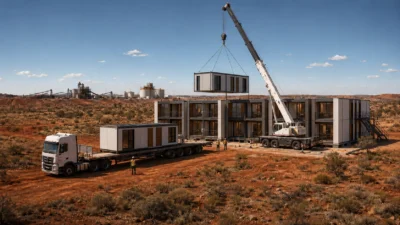
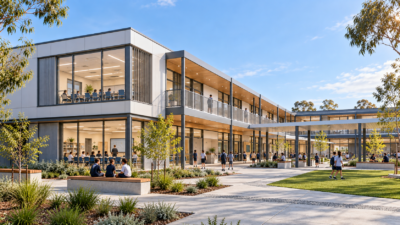
AI-generated conceptual illustration of modular building installation at a remote project site.
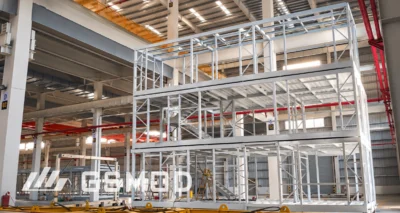
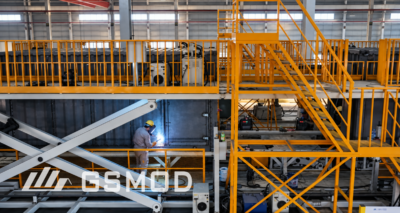
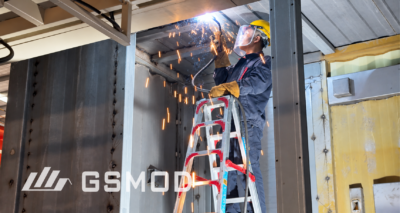
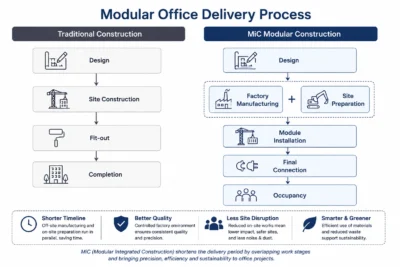
High factory completion. Volumetric modules can arrive with a substantial proportion of work finished, including structural frame, internal wall assemblies, electrical, plumbing, HVAC and bathroom fit-outs (where applicable), flooring, ceilings and selected fixtures. Higher completion reduces specialist work after delivery, cutting on-site coordination and rectification where access to trades is limited.
Parallel workflows. Site preparation and factory production run concurrently, which can shorten overall project programmes for suitable applications—especially where operational start dates are critical, such as mining or infrastructure works.
Rapid operational readiness. Once on site, installation proceeds on a compressed schedule. Because modules arrive highly complete, the transition to operational use can be shorter than for a comparable site-built project, depending on project conditions.
Planning Transport and Installation
Volumetric modules cut individual material deliveries but are larger loads, so dimensions and weights must be assessed against transport limits, route constraints and site access—including bridge and load restrictions, height and width limits, turning radii and oversize permits. Some module configurations may fall within standard road transport limits, while others may require specialised vehicles or permits. Foundations, access roads and crane selection must be ready before arrival, and delivery sequencing is matched to the installation schedule to limit on-site storage. Modules are placed in a planned sequence that helps reduce unnecessary crane movements and supports efficient installation sequencing; on-site teams then complete inter-module connections, weatherproofing and final fit-out. Factory inspection of completed three-dimensional modules—MEP systems, interface coordination and finishes—helps reduce rectification where trades and materials are scarce.
Lifecycle Flexibility
Where systems are designed for disassembly, modules may be disconnected, transported and recommissioned at a new site, provided condition, connection design and new-site requirements are met—retaining embodied value and potentially reducing decommissioning waste. Additional modules can be factory-built and connected as operations grow, and modules may be repurposed for new uses depending on design and condition. Relocation is not automatic: it depends on original connection design, module condition, transport route, new-site structural and services requirements, and local approvals.
Which Remote Projects Benefit
- Mining and resources– administration, operations, project-management and control buildings for long-duration or relocatable operations. Less relevant for small temporary huts or basic low-spec field offices.
- Energy and processing– oil, gas and renewables projects needing high-quality operational space early, where reduced site construction supports scheduling.
- Major infrastructure– multi-year programmes and large compounds requiring substantial office facilities for extended periods.
- Regional and government– service facilities where conventional construction is logistically difficult and local trades are constrained.
When Is a Volumetric Modular Office Suitable?
Volumetric modular offices become more relevant when:
- Remote site labour is expensive or hard to maintain
- The building needs a high degree of internal completion
- Programme certainty and minimal site activity are priorities
- Road and site access support volumetric delivery and crane installation
- The building has sufficient operational duration or lifecycle value
- Future relocation or expansion has commercial value
They may be less suitable when:
- Route constraints prevent practical volumetric transport
- The project is extremely small and basic
- Local site labour is readily available and inexpensive
- The building is very short-term and low specification
A project-specific feasibility assessment—route analysis, foundation design and installation planning—determines suitability.
Conclusion
Remote Australia’s labour shortages, transport complexity, harsh climates and limited infrastructure can create conditions in which volumetric MIC becomes a viable delivery option for the right office project. The potential advantage lies in high factory completion, reduced on-site labour, faster operational readiness and relocation or expansion potential.
However, volumetric modular is not universal. Site access, transport routes, operational duration and quality requirements must be assessed per project. For the broader case across Australia, see our overview of modular office buildings.
Frequently Asked Questions
Why are modular offices suitable for remote Australian projects? Volumetric modular offices suit remote projects where reducing prolonged on-site construction and achieving high factory completion are priorities. Factory production completes many components before transport, helping address labour shortages and harsh site conditions.
What is the difference between volumetric modular and panelised prefabricated offices? Volumetric buildings are delivered as factory-completed three-dimensional modules with integrated services, finishes and fixtures. Panelised prefabricated offices are assembled from factory-made wall, floor or roof panels and generally require more on-site assembly than volumetric modules. Volumetric offers higher completion and less site work, but different transport and installation needs.
How are modular offices transported to remote locations? Transport depends on location, module size and access—road, specialised vehicles, sea freight or a combination. Route assessment ensures safe delivery in the correct installation sequence.
Are volumetric modular offices suitable for mining projects? They suit mining and resource projects where remote deployment, phased expansion and future relocation matter, particularly where operators need a higher-quality workplace with integrated services for a meaningful period.
Can remote modular offices be relocated after a project finishes? Many systems are designed for relocation and adaptation. Depending on design and condition, modules may be disconnected, transported and reused. Relocation is not automatic and depends on connection design, module condition, transport route and new-site requirements.
How do modular buildings handle harsh Australian conditions? Modules are designed to local climate requirements, including insulation, structural performance, weather protection and the National Construction Code. Projects in cyclone-prone regions may require structural design for project-specific wind actions, while sites exposed to bushfire risk may require assessment against an appropriate Bushfire Attack Level (BAL) classification. Project-specific design addresses these conditions.

Vincent Y.N. Mak
16 years of experience in modular architecture, MiC construction and international modular project management.