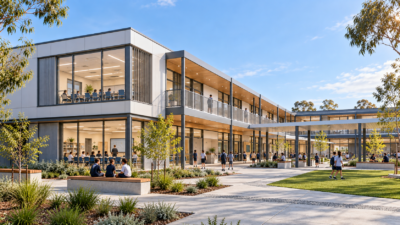


Modular classrooms typically cost between $100 and $300 per square foot in the United States, AUD $2,300 to $4,500 per square metre supply-only in Australia, and £800 to £2,000 per square metre in the UK. These figures should be treated as early budgeting references—the final all-in cost depends on classroom type, site conditions, and what the supplier’s quote actually includes. This guide breaks down the cost by classroom type, explains what drives the price, and compares modular against traditional construction on both budget and timeline.
What Does a Modular Classroom Cost?
Classroom type determines cost more than square footage alone. The gap between a standard teaching room and a fully fitted science laboratory is substantial, even at the same floor area.
Standard Classrooms
In the US, modular classroom costs commonly fall around $100–$300 per square foot, depending on specification, installation scope, and site requirements, with a standard single classroom generally landing between $100,000–$200,000 before site work.
In Australia, supplier pricing data from NSW modular education building providers shows delivered costs of AUD $320,000–$430,000 for a 75sqm classroom in Sydney—approximately AUD $4,300–$5,700 per square metre all-in; these are supplier benchmarks, not a national average.
In the UK, older supplier benchmarks place a double modular classroom at around £95,000–£120,000 before groundworks, crane hire, and transport, at roughly £800–£900 per square metre.
Schools that need modular education buildings for fast capacity expansion can procure single classrooms or multi-room blocks, depending on enrolment demand and site availability.
STEM Labs and Specialist Classrooms
Science laboratories, computer suites, and arts classrooms carry a meaningful premium over standard teaching rooms. In the US, modular science labs typically cost $150 or more per square foot due to specialist plumbing, ventilation, and electrical infrastructure. Computer suites require reinforced electrical supply and structured data cabling. Multi-purpose classrooms with open layouts need heavier structural elements. Expect specialist classrooms to run 30–60% above standard classroom rates regardless of market.
Multi-Classroom Building Complexes
When schools procure multiple classroom modules together—teaching blocks, administration rooms, staff spaces, and sanitary facilities—economies of scale apply. Permanent modular buildings designed for long-term occupancy cost more than basic single classrooms, particularly where higher specification, full MEP integration, and compliance for permanent use are required. In the UK, multi-classroom modular buildings command £1,000–£2,000 per square metre for higher-specification facilities. Traditional school construction in the UK is often significantly higher than basic modular classroom supply costs, especially in high-cost cities such as London, making modular a cost-effective option for schools with budget constraints.
What Drives the Cost Up or Down?
Classroom Type and Specialisation
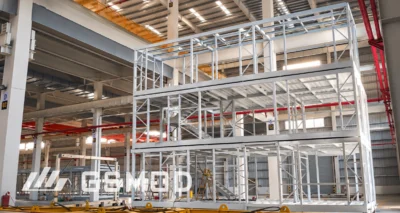
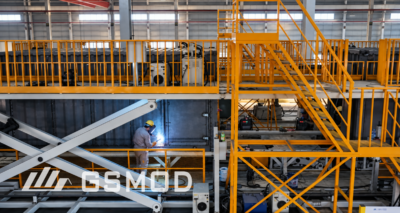
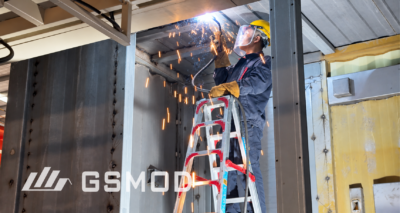
Standard classrooms with basic MEP connections represent the most cost-effective modular format. Every step toward specialisation—science gas supplies, enhanced ventilation, acoustic treatment, IT infrastructure—adds to both the supply cost and the commissioning time. In steel modular construction, MEP systems can be integrated and tested at the factory, which reduces field coordination time but does not eliminate the cost of the systems themselves.
Site Conditions
Site costs can add substantially to the final budget, especially where foundations, utility connections, access ramps, or constrained urban sites are involved. Foundation preparation, utility connections, ADA-compliant access ramps, and levelling all sit outside the modular supply price and vary significantly depending on ground conditions, access, and existing utility infrastructure. In Australia, NSW modular education building data shows the gap between supply-only (AUD $2,300–$4,500/sqm) and all-in delivered cost is driven almost entirely by groundworks, utility connections, and crane installation.
Permanent Installation
Permanent modular classrooms are designed for 50-year service lives, comply with full building code requirements, and can be treated as capital assets on school budgets. The additional cost over a basic specification lies in foundation depth, full utility connection, and compliance for permanent occupancy—but the long-term value is straightforward: lower lifecycle cost, higher structural quality, and no ongoing lease obligations.
What’s Included in the Price?
A standard modular classroom supply package typically includes:
- Structural frame and external envelope — walls, roof, cladding, windows, and doors
- Internal fit-out — partition walls, ceilings, flooring, and internal doors
- Basic MEP — electrical, plumbing, and HVAC roughed in to connection points
- Factory testing — all systems validated before departure
What is almost always excluded: foundation and groundworks, utility connections from the site boundary, furniture and teaching equipment, permits and compliance fees, landscaping, and accessibility ramps. Before comparing quotes from different suppliers, confirm exactly what scope each price covers.
Hidden Costs to Budget For
Beyond the supply quote, several costs catch school budgets off guard.
Permits and inspections vary by jurisdiction, but are rarely zero—building permits, fire safety inspections, and education-specific compliance checks all carry fees that need to be planned at the feasibility stage, not discovered at handover.
Furniture and teaching equipment are almost never included in a modular supply contract. Desks, chairs, whiteboards, AV equipment, science lab benches, and storage units are separate procurements. For a standard classroom, these can add meaningfully to the total project cost.
Ongoing utility costs begin the moment the classroom opens. Heating, cooling, and electricity costs depend on the insulation specification and HVAC efficiency of the modular unit—worth comparing between suppliers, not just on purchase price.
Annual maintenance costs depend on material quality, installation quality, climate, and usage intensity. Budget a maintenance allowance from year one rather than treating it as a future problem.
How Do Modular Classrooms Compare to Traditional Construction?
| Modular (US) | Traditional (US) | |
| Standard classroom | $100–$200/sqft | $120–$200+/sqft |
| Timeline | 8–16 weeks | 8–18 months |
| Budget certainty | Factory-fixed | Variable, change-order risk |
| Disruption to the campus | Minimal | Significant during build |
In the UK, modular classrooms cost £800–£2,000/sqm—significantly below traditional school construction costs, particularly in higher-cost cities. In Australia, modular supply costs of AUD $2,300–$4,500/sqm compare favourably against traditional classroom construction, which runs higher once full sitework and compliance costs are included.
Where Modular Has the Edge
Cost per square foot is comparable to traditional for standard classroom types—the real advantage of modular is schedule certainty and minimal campus disruption. A modular classroom block can be crane-installed outside school hours, often over a single weekend, with no disruption to teaching during term. Traditional construction on an active school site requires months of noise, access restrictions, and safety management. The long-term case for modular classroom infrastructure is examined in permanent modular construction analysis covering durability, compliance, and lifecycle cost.

Where Traditional Still Makes Sense
Highly customised classroom designs—curved facades, atriums, complex multi-storey layouts—reduce the modular cost advantage as engineering adaptation consumes the schedule saving. Very small single-room additions may also not justify modular logistics. In remote locations without crane access or adequate road access, site-built construction can be more practical.
Why Modular Construction Matters for School Projects
School construction has fixed windows. A classroom that needs to be operational for the September term cannot slip to November. Modular construction’s fixed factory timeline—typically 8–16 weeks from order to installation—aligns with academic calendars in a way that traditional construction cannot guarantee. In Australia, NSW modular classroom programmes typically run 8–12 weeks from design sign-off to handover, structured to align with Department of Education term planning cycles. For schools that have missed a traditional construction window, modular is often the only method that can deliver within the required timeframe.
For custom modular solutions designed around specific classroom layouts and site requirements, factory production and site preparation run in parallel, compressing the programme without compressing the quality of what’s delivered.
Conclusion
The cost of a modular classroom depends on the type of space, specification level, site conditions, and what the supplier’s quote includes. A single standard classroom and a multi-room STEM block sit at opposite ends of the cost range. Request quotes that separate supply scope from site scope, confirm what compliance documentation is included, and compare suppliers on the same basis. GS Modular manufactures steel modular educational buildings for permanent installation, with factory-integrated production from a 70,000-square-metre base in Foshan, China.
FAQ
How long does it take to build a modular classroom?
Standard classroom modules take 8–16 weeks from order to installation in most markets. In Australia, NSW modular classroom programmes typically run 8–12 weeks from design to handover. Multi-classroom complexes take longer depending on scope.
Can modular classrooms be permanent?
Yes. Permanent modular classrooms are designed for 80+ year service lives, comply with full local building codes, and are structurally equivalent to site-built construction.
What is the cheapest type of modular classroom?
Standard classrooms with basic MEP connections and no specialist fit-out represent the most cost-effective entry point. In the US, these start from around $100 per square foot before site work.
Do modular classrooms need planning permission?
Yes. Modular classrooms require full planning and building regulation approval in all major markets. Requirements vary by jurisdiction—confirm local compliance obligations at the design stage.